Signed in as:
filler@godaddy.com
Following the Migration of the North Atlantic Right Whale

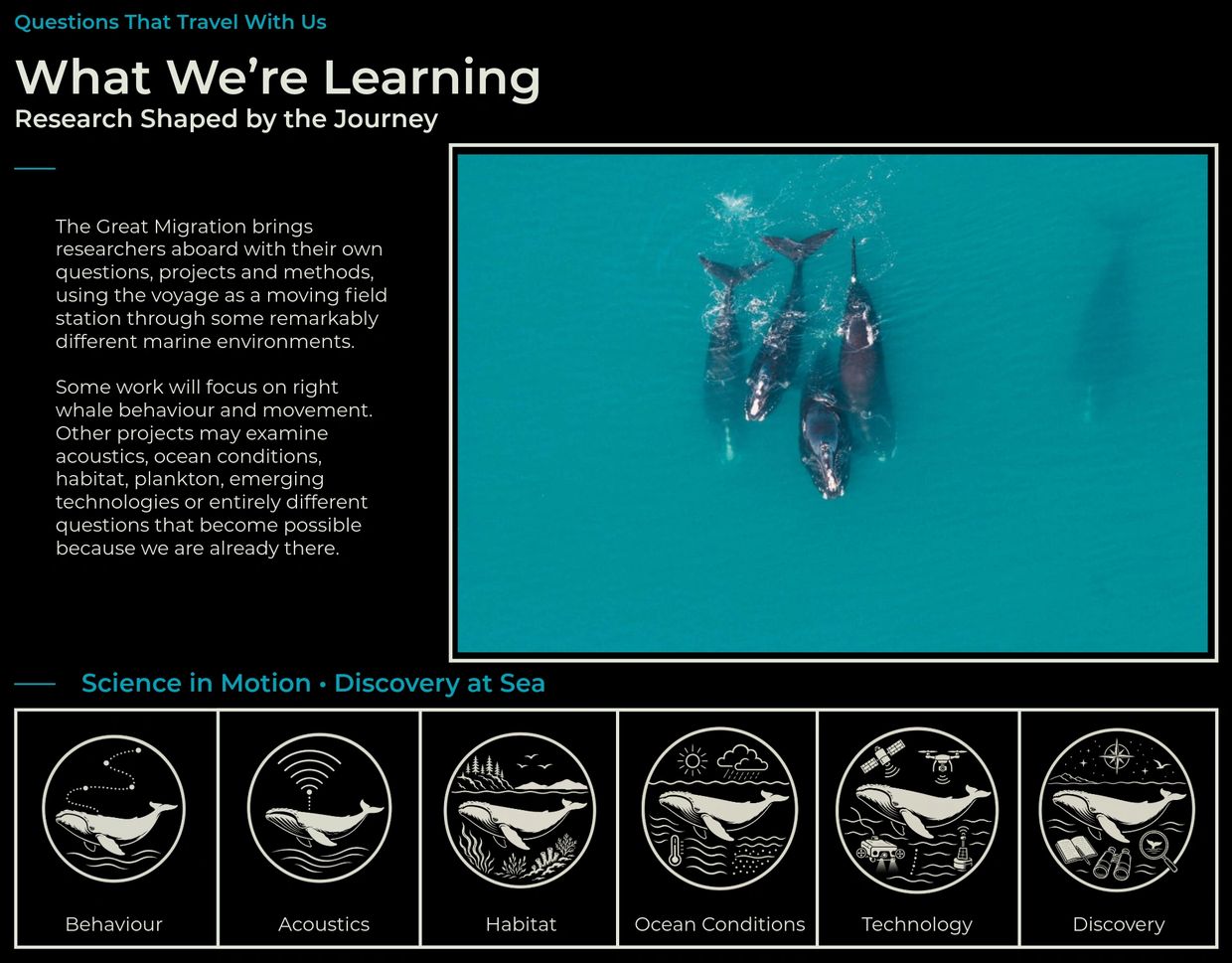
The Great Migration Expedition is a 2026–2027 research voyage tracing the annual migration of the critically endangered North Atlantic right whale along the Atlantic coast of North America. Combining science, education, storytelling, and Next Gen research, the expedition will document changing conditions across the interconnected ecosystems that support one of the world's most endangered whale species.
The Great Migration Expedition follows the annual journey of the critically endangered North Atlantic right whale from the feeding grounds of eastern Canada to the calving waters of the southeastern United States through vessel-based monitoring, environmental sampling, and Next Gen research projects.
The expedition is designed to document changing conditions across the full migration corridor rather than isolated regions.
WHY THIS MATTERS BEYOND RIGHT WHALES
Migratory species connect ecosystems separated by thousands of kilometres. Conditions encountered in one region can influence wildlife populations far beyond local waters.
As shipping activity, fisheries pressure, coastal development, ocean noise, and climate change continue to reshape the Atlantic, understanding these changes requires observation across the entire migration route.
PROGRAMME: THE MIGRATION CORRIDOR OBSERVATORY
The Observatory combines vessel-based observation, environmental monitoring, and collaborative research to examine conditions across the habitats used by North Atlantic right whales and the many species that share their journey.
Following the migration itself provides a broader understanding of how connected ecosystems are changing over time.
TRACKING A CONNECTED ATLANTIC
The Great Migration Expedition is structured around the seasonal movement of wildlife through one of the busiest and most heavily used coastlines in the world.
By travelling the migration corridor from north to south, the expedition supports:
Each leg of the expedition contributes to a broader picture of how wildlife experiences the Atlantic Ocean.
A PLATFORM FOR RESEARCH AND DISCOVERY
The migration corridor spans multiple ecosystems, jurisdictions, and research priorities, yet many studies remain focused on individual regions.
Maintaining independent vessel access along the route provides opportunities for environmental monitoring, collaborative research, education, and storytelling across the full range of habitats used by migratory species.
Duration: Summer 2026 – Spring 2027
Route: Montreal → Gulf of St. Lawrence → Atlantic Canada → U.S. East Coast → Southeastern United States
Potential Extension
Amazon Basin
Platform: R/V Stanley (Steel Research Trawler)
Disciplines
Outputs
GETTING ONBOARD
The Great Migration Expedition is not a commercial voyage.
Crew and contributors are selected based on:
Potential roles may include:
All roles are application-based and subject to availability.


The Great Migration Expedition is an active, evolving voyage. As North Atlantic right whales travel thousands of kilometres between feeding and calving grounds, the conditions they encounter continue to change.
Those interested in supporting, following, or collaborating with this work are invited to stay connected as the expedition progresses.
Migratory species do not experience the Atlantic as separate regions. They move through a connected network of ecosystems shaped by climate, commerce, human activity, and environmental change.
Understanding that journey requires observation across the full migration corridor.
Expedition Audacity Research Foundation
Copyright © 2018 - 2026 Expedition Audacity - All Rights Reserved.
11006126 Canada ltd - Expedition Audacity Research Foundation - Fondation de recherche Expédition Audace - 1726380-5 ~ Beaverton, Ontario, Canada
Expedition Audacity Research Foundation - E.A.R Foundation 33-3246352 - 501(c)3 ~Dover, Delaware.
Powered by Audacity