Signed in as:
filler@godaddy.com
Signed in as:
filler@godaddy.com
Field Validation & Research Acceleration.
Technology at Sea is an applied field-testing programme operated by the Expedition Audacity Research Foundation. It provides universities and their innovation ecosystems with structured, ethical access to real-world ocean environments — moving technologies, methods, and research systems out of the lab and into reality.
In this programme, technology includes not only hardware, but also field methods, sampling systems, analytical tools, and experimental research approaches that require exposure to authentic marine conditions.
The ocean is the ultimate stress test.
We provide safe, responsible access to that reality.
Purpose, participation, and practical application.

Technology at Sea exists for one reason: real environments expose real weaknesses — and real potential.
Controlled simulations, tank testing, and dockside trials are essential. But they cannot replicate wind, waves, current, salinity, biofouling, cold, heat, motion, or time.
Technologies and scientific systems designed for marine, coastal, riverine, or high-energy environments must be tested where those forces are unavoidable.
We offer deliberate, structured access to those conditions — safely, ethically, and with purpose.
Intended participants and institutional partners.

University entrepreneurship and innovation centres.

Student engineering and design teams.

Faculty-led research groups testing deployable technologies or field methods.

Startups emerging from academic environments.

Technology transfer offices seeking field validation.

NGOs and research organisations testing environmental or rapid-response systems
This programme works with universities, not around them — aligning innovation with academic values, education, and responsibility.
Capabilities, support, and field access.

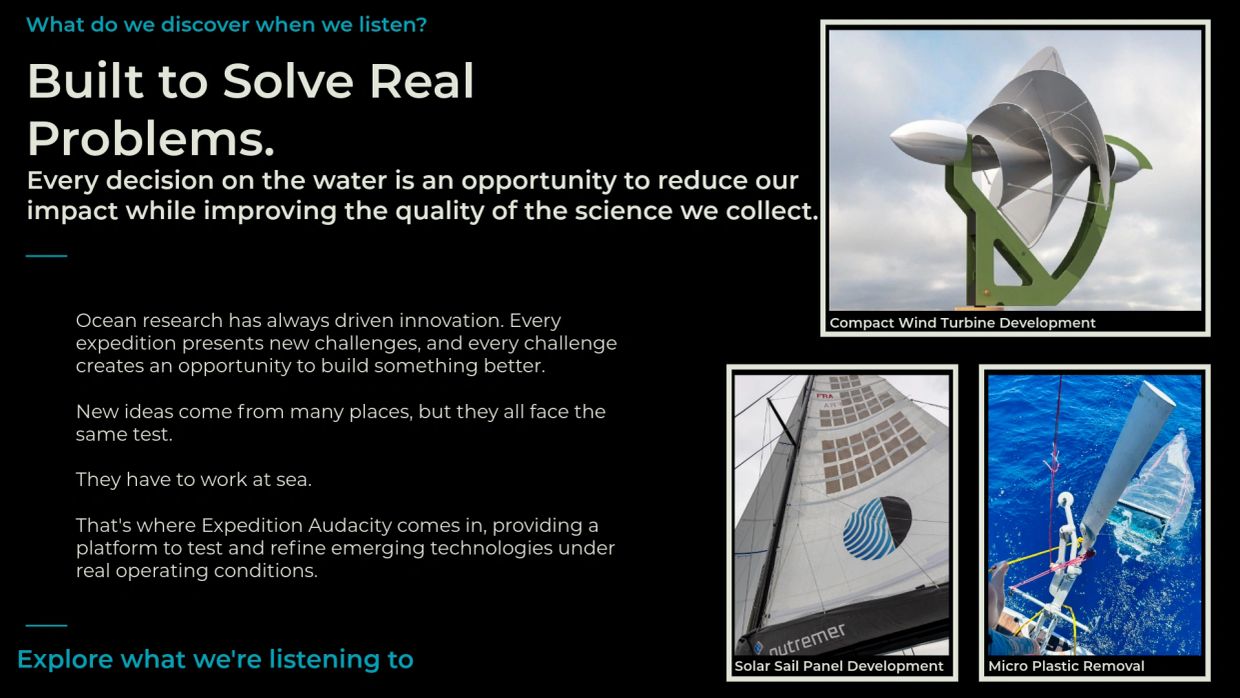
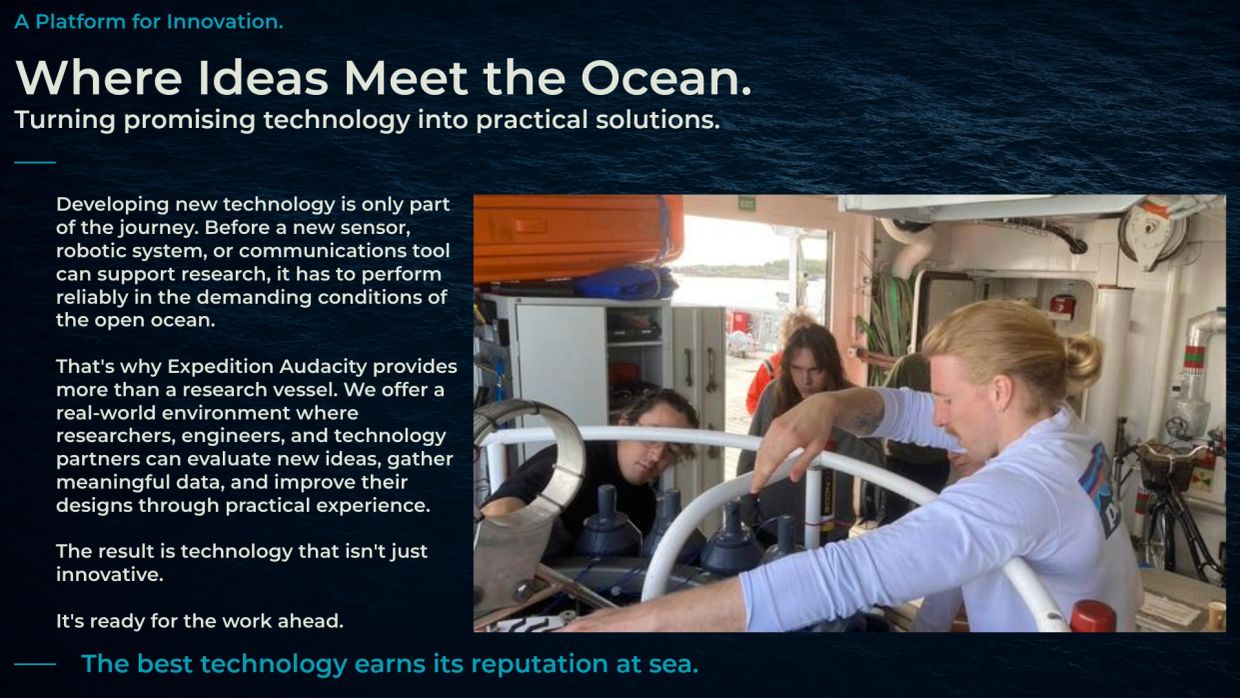
Deploy technologies, sampling systems, or research tools in real operational conditions — not staged demonstrations.

When systems fail, we help document how and why. Failure is data.

Test across Arctic, tropical, estuarine, offshore, and high-energy marine environments.

Custom mounting, power integration, deployment planning, recovery, and onboard support.

High-quality visual and written records suitable for grants, validation reports, publications, and academic review.

This programme supports technologies and scientific systems that benefit from exposure to reality, including:
If it needs saltwater, current, motion, mud, cold, or chaos — it belongs here.

1. Project Proposal
Submitted by the university, innovation centre, or programme lead.
2. Collaborative Planning
Objectives, timelines, regions, ethics, and technical needs defined together.
3. Field Deployment
Testing conducted aboard a working research vessel with expedition support.
4. Documentation & Review
Results, failures, and lessons captured clearly and responsibly.
Engagements are fee-based, supporting vessel operations, crew time, and logistics. Intellectual property remains with the originating institution or team.
Academic value, experiential learning, and risk reduction.

Most importantly, it teaches students and researchers that engineering and science don’t end at the lab door.
Standards that govern how this work is done.
We do not support testing that causes unnecessary harm or obscures accountability.
Projects suited for real-world ocean testing.
Proposals are reviewed on a rolling basis, aligned with expedition schedules.
Innovation doesn’t mature in perfect conditions.
It matures where assumptions fail, learning accelerates, and reality intervenes.
Technology at Sea exists to give the next generation of ocean technologies and research systems a place to prove themselves — honestly, responsibly, and in the environments they are meant to serve.
Expedition Audacity Research Foundation