.png/:/cr=t:0%25,l:0%25,w:100%25,h:100%25/rs=w:1240,cg:true)
People ask me this question all the time, usually at the end of a presentation. We'll spend an hour talking about whales, seafloor mapping, education, technology, or where Expedition Audacity is heading next. Then, just as everyone is packing up, somebody puts up a hand and says, "I've been told EAR has a great origin story. How did all this actually start?"
I always smile because the answer is almost never what they're expecting.
Most organizations can point to a meeting, a business plan, or the moment someone decided to start a company. Expedition Audacity doesn't really have one of those. If anything, it feels like a series of small decisions that only made sense once I looked back and realized they were all connected.
The first of those decisions had nothing to do with research or education.
I just needed somewhere to live.
In 2017, family circumstances meant I was splitting my time between Nashville and Toronto. Rather than rent an apartment every time I came back to Canada, I bought an old project trawler from a friend and turned her into my floating home in Toronto Harbour. I named her Stanley after both of my grandfathers, and because she'd been built in Port Stanley, Ontario.
At the time I was working in film, building a career in stunts and special effects. If you'd asked me where I thought the next twenty years were heading, I'd have talked about movies. Marine research wasn't part of the plan, and Expedition Audacity didn't exist. As far as I was concerned, I'd simply bought an old boat with a very enthusiastic rust problem and a maintenance list that seemed to begin every morning with the reassuring words, "This shouldn't take long."
It never took long.
It took all weekend.
Not long after moving aboard, I somehow found myself helping in one of my nephew's elementary school classes. If you know me, you'll know I'm "Uncle Red" to far more children than I'm actually related to, and volunteering for that sort of thing has never been much of a sacrifice. Give me an excuse to spend the day with curious kids, and I'm usually through the door before anyone has finished asking.
Part of the morning involved watching a documentary about the Great Lakes. It only took a few minutes to realise I'd seen it before.
In fact, it was the same film I'd watched when I was in school.
The problem was, it had already looked old back then.
It had obviously been filmed decades earlier. David Suzuki was still a young man. Somehow, thirty years had passed and children were still sitting in classrooms watching exactly the same documentary.
I remember thinking, "Surely we can do better than this."
At the time, I had no idea that one thought, sparked by an old classroom film and a rather rusty trawler tied up in Toronto Harbour, would quietly send my life in a direction I'd never seen coming.
.png/:/rs=w:1240,cg:true,m)
Watching that old documentary, I couldn't stop thinking about my friend Rob Stewart.
Rob and I had been friends since public school, long before the rest of the world knew him through Sharkwater. Even back then he had an endless curiosity about the natural world, especially anything that lived in or around the water. He was never content simply knowing something existed. He wanted to understand it, share it, and convince everyone else it was worth caring about. That curiosity eventually changed the way millions of people thought about sharks and ocean conservation, but to me he was still just Rob.
By the time I was sitting in that classroom, Rob had been gone for several months, and I couldn't shake the feeling that there was no way he would have accepted those old films still being shown to children. He wouldn't have complained about it.
He would have grabbed a camera.
That thought stayed with me.
I already worked in film. I lived on a boat. Many of my friends were marine scientists, conservationists, university researchers, or worked for government agencies. Between us we had cameras, boats, expertise, and just enough optimism to mistake a lot of work for a good idea.
Stanley had never been intended as anything more than a floating home, but whenever we had time between television productions we started using her as a filming platform. What began as an attempt to update a few classroom resources gradually became The Little Red Trawler. We weren't trying to start an organization or launch careers in marine science. We just wanted to make educational films that reflected the world students were actually growing up in.
The irony was that I probably learned as much as the audience did.
The more time I spent alongside researchers, the more I realised how many remarkable stories never reached the public. Not because the science wasn't interesting, but because most of it lived in academic journals, conference presentations, or conversations between specialists.
Somewhere along the way I stopped thinking of documentaries as the destination and started seeing them as the bridge. A good story could connect researchers with classrooms, scientists with families, and discoveries with people who might never otherwise hear about them.
Looking back, it seems obvious.
At the time, it wasn't.
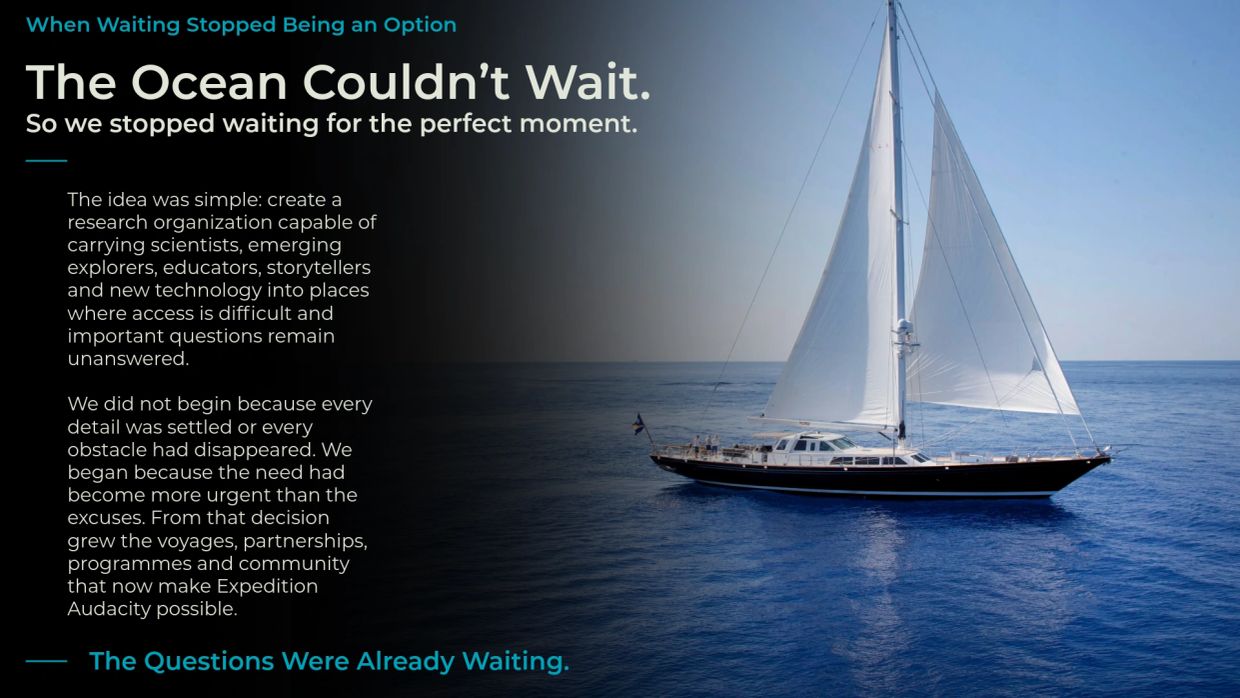
Around then another dream quietly started changing too. I'd always imagined retiring onto a sailboat and spending my days exploring the world with a camera. That was the whole plan.
Working on The Little Red Trawler complicated it.
The more time I spent with researchers, the less interested I became in only filming places and the more interested I became in filming the people trying to understand them. Somewhere along the way I stopped imagining sailing around the world by myself and started imagining inviting scientists aboard so they could tell their own stories.
It still felt like a retirement dream.
I just hadn't noticed it had already started without me.


For a while, that was enough.
I was enjoying my work in film, The Little Red Trawler was growing, and the idea of one day buying a sailboat to explore the world alongside researchers sounded like a pretty good retirement plan. Retirement was still years away. There was no reason to rush.
Then my friend Dirk died.
He'd travelled home for Christmas. A few days into the new year he stood up in his mother's living room, said he felt dizzy, and collapsed from a brain aneurysm. He was only a couple of years older than me, healthier than me, and then, just like that, he was gone.
His death made me realize how many friendships had quietly become birthday messages, Facebook comments, and the occasional text. That wasn't enough.
I started calling people.
One of those calls was to my friend Colin.
We'd met years earlier while I was living in San Diego. We'd always stayed in touch, but life has a habit of putting distance into even the best friendships. As we caught up, I told him how The Little Red Trawler had changed my thinking. The retirement dream wasn't really about making documentaries anymore. I wanted to buy the sailboat now, take researchers into the Northwest Passage, and tell the story of the science happening there.
I wasn't looking for approval.
I was just telling a friend what had been on my mind.
To my surprise, Colin never questioned whether it was possible. He didn't ask how I planned to pay for it or explain all the reasons it couldn't work. Instead, he started talking about the people I should meet, the conversations we should be having, and the things we'd need to think about if we were serious.
Before long we were talking almost every day. We'd solve one problem, discover three more, and then start all over again the next morning. The documentary idea gradually grew into something much bigger.
We were leaving for Oceans Week in New York in a matter of days and we still didn't have a name. Business cards had to be ordered, so Colin and I spent an evening throwing ideas back and forth, filling page after page with possibilities. Most of them deserved to stay in the notebook.
Eventually the conversation wandered onto movies. By that point I was about three-quarters plastered and had become convinced that naming an expedition after a film title, or at least shamelessly borrowing one, was an excellent idea.
Somebody mentioned 2001: A Space Odyssey. I don't remember exactly how the conversation unfolded after that, but my notebook gradually filled with increasingly questionable ideas: 2022: An Arctic Odyssey. An Arctic Oddity. An Arctic Audacity. I think Catastrophe even made an appearance at one point.
Fortunately, we had the good sense to stop for the night.
The next morning I went back through my notes. Most of what I'd written made a lot less sense in daylight than it had the night before, but one line kept standing out:
Expedition Audacity: An Arctic Odyssey.
We printed the business cards, and a couple of days later I was on a flight to New York carrying a box that still smelled like fresh ink.
Around that time, Colin reached out to Don Walsh.
When Don agreed to become Expedition Audacity's first advisor, we had Stanley, a freshly printed box of business cards, and an idea that was still finding its feet. Most evenings were spent scrolling through YachtWorld and Boat Trader, convincing ourselves that if we looked long enough we'd eventually stumble across the perfect expedition vessel hiding in the classifieds.
Don believed the idea was worth encouraging.
By the time I arrived in New York, Expedition Audacity was only a few days old. I'd expected to spend the week listening. Instead, I spent most of it introducing people to an organization that had barely existed long enough for the ink on the business cards to dry.
One afternoon at an Explorers Club event, I found myself talking with Sylvia Earle about an idea that would eventually become our Hope Spot Surveys. In the middle of a room full of people, she took both of my hands in hers, smiled, and told me she loved the idea.
I honestly can't remember much else about that conversation.
I remember her taking my hands.
Another evening, after United Nations Oceans Day, a group of us ended up around a table in a dive bar. I spent a good part of the evening trying to work up the nerve to ask Fabien Cousteau whether he might ever consider becoming involved with Expedition Audacity.
I never got that far.
Before I could ask the question, Fabien asked how he could become part of what we were building.
That wasn't how I'd imagined the conversation going.
During the week I also met Joe Grabowski, founder of Exploring By the Seat of Your Pants. That conversation eventually grew into one of Expedition Audacity's longest-running educational partnerships, connecting our expeditions with classrooms around the world.
A week earlier, Expedition Audacity had been a name we needed for a business card.
By the time I unpacked my suitcase, it felt like something much more real.

By the fall of 2021, Expedition Audacity felt like more than an idea.
We still had Stanley, plenty of ambition, and no shortage of reasons why none of it should work.
A few months later, while I was working in the film industry, I was assaulted and suffered a traumatic brain injury. My career in film ended much sooner than I ever expected.
For a while I was simply trying to work out what life looked like after that.
Expedition Audacity, however, had other ideas.
The phone kept ringing. I'd finish one conversation with a researcher and find myself talking with a teacher. One afternoon would be spent discussing new technology, and by evening someone else would be asking whether we could help with a completely different project. Every time I thought I'd caught up, another email arrived.
I don't remember ever making a conscious decision to work on Expedition Audacity full time. There wasn't a meeting or a grand announcement. Somewhere along the way it simply became what I did every day.
Looking back, almost nothing happened the way I'd expected.
Buying Stanley was a practical decision. I needed somewhere affordable to live while I was splitting my time between Toronto and Nashville. Volunteering in an elementary school wasn't part of a master plan. Neither was making educational films. Calling Colin after Dirk died wasn't a strategy, and neither was spending an evening trying to name an organization after movie titles.
One conversation led to another.
Researchers introduced us to other researchers. Teachers introduced us to classrooms. One project became two, then three, and before long Expedition Audacity was heading in directions I never would have predicted.
People occasionally ask what our long-term strategic plan looked like back then.
The honest answer is that it looked a lot like my browser history: YachtWorld, Boat Trader, grant applications, research papers, and entirely too much tea.
Some ideas worked.
Some didn't.
Fortunately, enough of them did.
The organization has changed more times than I can count. New people have joined with ideas and experience we didn't have. Others have moved on to new adventures. Every one of them has left something behind that made Expedition Audacity a little different from what it had been before.
These days my calendar looks nothing like I imagined all those years ago. I'm more likely to be talking with a university than a television producer, thinking about research permits instead of filming permits, or wondering how we managed to say yes to another project.
I'm still about twenty years from retirement.
Somewhere along the way, I seem to have accidentally built myself the sort of job you never really retire from.
People sometimes ask whether this is the end of the story.
Not even close.
Most of what you've just read happened because one ordinary decision led to another. None of us knew where it would end up, and to be honest, we still don't.
That's probably my favourite part.
Expedition Audacity is still changing. New people keep arriving with ideas we'd never have come up with on our own. New opportunities appear where we weren't looking for them. Every voyage teaches us something we didn't know before.
If you've made it this far, you know where we came from.
The rest of this website is about where we're headed.

Expedition Audacity Research Foundation
Copyright © 2018 - 2026 Expedition Audacity - All Rights Reserved.
11006126 Canada ltd - Expedition Audacity Research Foundation - Fondation de recherche Expédition Audace - 1726380-5 ~ Beaverton, Ontario, Canada
Expedition Audacity Research Foundation - E.A.R Foundation 33-3246352 - 501(c)3 ~Dover, Delaware.
Powered by Audacity
