Registered Canadian & U.K. charity & U.S. 501(c)(3).
Josie the Kraken is not just a character.
She is part of the real history of Expedition Audacity and the E.A.R. Foundation — a reminder of why this work exists and who it is meant to protect.
Josie is the daughter of one of Captain Red’s closest friends, born during a moment when life was changing in a very big way. Around the time Josie was hatched, Expedition Audacity was transforming from a passion project — a hobby fueled by curiosity and care — into a life-defining calling.
The ocean was no longer just a place to explore.
It became something to defend.
Why She’s Called “The Kraken”
Josie earned her nickname before she was even born.
One day, her mother told Captain Red that she could see and feel Josie trying to kick her way out through her bellybutton — determined, restless, and clearly in a hurry to meet the world.
Captain Red laughed and said:
“That’s no ordinary baby. That’s a Kraken trying to escape.”
The name stuck.
Not because krakens are scary —
but because they are powerful, curious, and impossible to ignore.
Josie and the World
As Expedition Audacity grew, so did the idea that this work wasn’t only about science, vessels, or data — it was about the next generation.
Children who would inherit the ocean.
Children who deserved stories where the sea is alive, worth protecting, and full of friends.
That’s why Josie appears in the R/V Audacity logo, sitting on top of the world.
She represents:
- curiosity instead of fear
- care instead of conquest
- playfulness paired with responsibility
She reminds us that the planet doesn’t belong to us — we are holding it for her.
Bennett the Kaiju
Josie’s younger brother Bennett is very real too.
Nicknamed “the Kaiju” by Uncle Red, Bennett earned his name the way only little brothers can — by being much stronger than he realises, fiercely loyal, and always ready to help when things get tough.
In the stories, Bennett’s strength is gentle.
In real life, that’s exactly the kind of strength the world needs more of.
Why These Stories Exist
The stories of Josie the Kraken are told for children — because children understand wonder instinctively.
But they are also here for adults.
For donors, partners, and supporters who may stumble onto this page and wonder why a serious research foundation makes space for a kraken, a kaiju, and tall ships with personalities.
The answer is simple:
Because protecting the ocean isn’t only about stopping harm.
It’s about teaching love.
If a child grows up loving the sea,
they will fight for it when it matters.
Josie reminds us who we are doing this for.
She is not a mascot.
She is not a cartoon.
She is a promise.

The real Josie the Kraken and Bennett the Kaiju.
The Adventures of Josie the Kraken


Josie the Kraken and the Day the Ocean Giggled
Deep beneath the sparkly blue waves, where coral castles glow like bedtime lights, lived Josie the Kraken.
Josie was small for a kraken, but don’t let that fool you — she had eight wiggly arms, a laugh that bubbled like soda, and a habit of turning ordinary days into adventures.
Josie lived with her family in a cosy reef cove.
Her baby brother Bennett the Kaiju was still learning how big he was. When Bennett sneezed, tiny waves splashed. When he yawned, fish thought it was bedtime. Josie loved him anyway and helped him practise his inside roars.
Her dad, Comrade Julio, was a big, tall, bald bear with the world’s best hugs. His hugs were so strong they could squeeze worries right out of you. He liked to stand guard on the rocks and say important bear things like,
“Teamwork makes everything better,” and, “Has anyone seen my sandwich?”
Josie’s mum was a Dragon, and she worked very hard making fire at work — the safe kind, the helpful kind, the keeps-the-world-running kind. When she came home, she always smelled a little like toasted marshmallows.
One morning, Josie popped her head above the water and gasped.
“UNCLE RED!”
Sailing across the sea was her best friend — Uncle Red, the tall ship captain. His ship creaked and hummed like it was alive, and its sails caught the wind like giant wings. Uncle Red protected the ocean, helped lost creatures find their way home, and always waved first.
Today, Uncle Red rang his ship’s bell.
“Josie! Adventure alert!”
Adventure alert was Josie’s favourite kind of alert.
“The Ocean is feeling giggly today,” Uncle Red said. “Too much trash, not enough tidying. Think you can help?”
Josie saluted with all eight arms at once.
“Aye aye!”
She zoomed through the water, picking up lost bottles, old nets, and a very confused rubber boot that thought it was a fish. Bennett helped too, carefully carrying things with his tiny kaiju claws. When he got tired, he sat down and accidentally made a small island. Everyone agreed that was still helpful.
Comrade Julio cheered from the rocks.
“That’s my team!”
Mum the Dragon warmed the chilly water just a bit so everyone stayed comfy.
By the time the sun dipped low, the ocean sparkled again — happy, clean, and calm.
The sea made a soft whoosh sound.
That meant thank you.
Uncle Red tipped his hat.
“Well done, Protector Kraken.”
Josie beamed.
She hadn’t just gone on an adventure — she’d helped her home.
That night, Josie curled up beside Bennett, who fell asleep mid-roar.
Dad tucked them in with a bear hug.
Mum blew a tiny fire-light like a night lamp.
Josie smiled and whispered,
“Tomorrow, we’ll do it all again.”
Because when you’re Josie the Kraken, every day is an adventure — and the ocean is family.

Josie the Kraken and the Very Busy Visit
Josie the Kraken woke up with a POP.
Not a bubble pop — an excited pop.
Today was the day Aunt Seahorse and Uncle Seahorse were coming to visit!
Josie zoomed in happy circles around her reef home. She straightened the coral chairs, lined up the shiny shells, and practised her best polite smile.
Then she stopped.
“Oh no…” Josie whispered.
Aunt Seahorse and Uncle Seahorse didn’t come alone.
She had…
LOTS of cousins.
So many seahorse cousins.
Tall ones.
Tiny ones.
Twisty ones.
Zoomy ones.
Seahorses who asked questions like:
“Can I sit here?”
“Is this my seat?”
“Why is this blue?”
“Why is THAT blue?”
Josie loved her cousins — but sometimes all the wiggling and talking made her feel like her head was full of bubbles.
Luckily, help was on the way.
In swam Grandma and Grandpa Walrus.
Grandma Walrus had long whiskers and a calm smile.
Grandpa Walrus had a deep voice and knew exactly when to say,
“Everyone take a big breath.”
Just seeing them made Josie feel better.
Soon the reef filled with happy chatter as Aunt and Uncle Seahorse arrived — followed by cousin after cousin after cousin.
Bennett the Kaiju tried to count them, but fell asleep at “seven and a half.”
The reef felt very full.
Very busy.
Very… splashy.
Josie took a quiet breath and wrapped one tentacle around herself.
That’s when a bell rang.
DING.
Uncle Red’s tall ship glided into view.
“Well now,” Uncle Red called, “this looks like a perfect day for an adventure!”
“ADVENTURE!” shouted the cousins.
Before Josie could worry, Uncle Red smiled at her.
“Don’t worry, Kraken. I’ve got a plan.”
He led them to a waterfall — a big one, where the water rushed down like giggles falling from the sky.
“Everyone ready?” Uncle Red said.
The cousins squealed.
Grandpa Walrus chuckled.
“Hold on tight.”
One by one, they slid down the waterfall together — spinning, laughing, splashing — until they landed in a calm, quiet pool below.
The water there was gentle.
The noise softened.
The bubbles floated slowly.
Josie felt her shoulders relax.
“This is nice,” she said.
Grandma Walrus smiled.
“Sometimes the best part of a big day is finding the calm.”
They floated together, watching the cousins drift and yawn.
Bennett snored.
A seahorse cousin used him as a pillow.
Everyone agreed that was acceptable.
As the sun shimmered above, Josie smiled.
Big families could be loud.
Big adventures could be busy.
But with the right people —
and a waterfall ride —
everything felt just right.

Josie the Kraken and the Shy Jellyfish
One peaceful morning, Josie the Kraken was practising her slow swimming.
Not zooming.
Not spinning.
Just floating.
That’s when she noticed a soft glow behind a rock.
“Hello?” Josie whispered.
The glow flickered.
Behind the rock floated a jellyfish — small, round, and very, very shy.
When Josie looked at it, the jellyfish’s glow dimmed almost all the way off.
“Oh!” said Josie. “Sorry. I didn’t mean to startle you.”
The jellyfish peeked out. Just a little.
Josie smiled — but not too big — and sat quietly in the water.
“I’m Josie,” she said softly.
“You don’t have to talk.”
The jellyfish didn’t talk.
But it glowed a tiny bit brighter.
Josie waited.
Bubbles floated past.
A fish yawned.
The ocean hummed.
Slowly, the jellyfish drifted closer.
When it felt comfortable, it glowed brighter.
When a loud fish swam by, it dimmed again.
“Oh,” Josie said. “You glow when you feel safe.”
The jellyfish wiggled.
That meant yes.
Just then, Bennett the Kaiju splashed by — not on purpose — but loudly.
The jellyfish’s glow vanished.
“Oh no,” Josie whispered.
“It’s okay, Bennett. Let’s use quiet fins.”
Bennett tried.
Very hard.
The jellyfish peeked out again and glowed — a soft blue, like bedtime light.
Uncle Red sailed past above them and rang his bell once.
Ding.
The jellyfish glowed bright green — then pink — then yellow.
“It likes gentle sounds,” Josie realised.
Josie didn’t touch.
She didn’t rush.
She just stayed.
After a while, the jellyfish floated right beside her.
It glowed brighter than ever.
Josie smiled.
“You don’t have to be loud to be bright,” she said.
The jellyfish glowed its brightest glow of all.
That night, as Josie curled up at home, she looked out at the reef.
Some lights were big.
Some lights were small.
But every light mattered.
Josie the Kraken and the Frisky Whiskey
One sunny morning, Josie the Kraken heard a very familiar sound.
Splash!
Woof!
Splash!
“That sounds like Frisky Whiskey,” Josie giggled.
Sure enough, there was Uncle Red’s dog — brown, fluffy, and very busy — paddling through the water with a ball in his mouth and a smile on his face.
“WHISKEY!” Uncle Red called.
Whiskey didn’t hear him.
Whiskey was swimming.
Josie popped up beside them.
“Can I play too?”
Uncle Red grinned.
“Josie, this is your moment.”
Uncle Red tossed a ball.
Splash!
Whiskey zoomed after it.
Josie tossed a ball.
Splash!
Whiskey zoomed again.
Then Josie used two arms.
Then four arms.
Then — because why not — eight arms.
Balls flew everywhere.
Splash!
Plop!
Ker-splash!
Whiskey didn’t know where to go first.
“This is the best day of my LIFE,” Whiskey thought, probably.
Uncle Red laughed so hard he had to sit down.
“I love having you here, Josie,” he said.
“You’ve got more arms than I’ve got pockets.”
They played all morning.
They played all afternoon.
Whiskey chased.
Josie threw.
The ocean sparkled with happy splashes.
Eventually, Whiskey slowed down.
His tail wagged… slower… slower…
Josie floated beside him.
“Nap time?” she asked softly.
Whiskey climbed up onto Josie’s tentacles, curled into a warm, soggy ball, and sighed.
Josie wrapped her arms around him — all eight, gently.
Uncle Red watched and smiled.
The ocean went quiet.
The sun shimmered.
The day felt full.
Josie and Whiskey napped together, happy and tired.
Because the best adventures don’t always end with a splash…
Sometimes they end with a cuddle.
Josie the Kraken and the Tangled Trouble
One bright afternoon, Josie the Kraken was out playing with her friends near the reef.
They played tag through the coral.
They raced bubbles to the surface.
They pretended a rock was a castle and that Josie was the queen with eight royal arms.
That’s when Josie spotted something strange.
Long, thin strings floated through the water like ghosty spaghetti.
“Ooo, what’s that?” one of her friends asked.
Josie reached out with a tentacle.
Uh-oh.
SNAG.
Another tentacle moved.
SNAG.
“Oh no,” Josie said as she gently wiggled.
“I think I’m stuck.”
Old fishing line wrapped around her arm… and another… and another.
Josie stayed calm, but her heart thumped.
“I can’t get loose,” she said.
Her friends backed up, worried.
Just then—
CHOMP.
Bennett the Kaiju appeared.
He looked at the fishing line.
He looked at Josie.
He made his serious kaiju face.
“No worry,” Bennett said.
CHOMP CHOMP.
Bennett carefully chewed through the fishing line — not fast, not wild — just strong and steady.
SNAP.
Josie was free.
She wrapped her arms around Bennett.
“Thank you, baby brother.”
Bennett smiled.
“Helping.”
But when they looked around, they saw more.
Old fishing nets.
More tangled lines.
Trash hiding between rocks.
“This isn’t safe,” Josie said quietly.
That’s when help arrived.
Captain Red sailed in close, scanning the water.
Comrade Julio climbed onto the rocks, tall and steady.
“We’ll take care of this,” Captain Red said.
Together, they worked.
Josie used her eight arms to gently gather the nets.
Captain Red lifted them away safely.
Comrade Julio made sure no animals were stuck or scared.
Bennett stood guard — just in case more chewing was needed.
It took time.
It took teamwork.
But slowly, the water cleared.
The reef looked open again.
Safe again.
Josie’s friends cheered.
Captain Red smiled.
“The ocean should be a playground, not a trap.”
Josie nodded.
That evening, Josie floated with her friends, watching the sun shimmer above.
“Thank you for saving me,” she told Bennett.
Bennett yawned.
“Always.”
Josie smiled.
Because when everyone looks out for each other,
the ocean stays safe —
and playtime can always continue.
Josie the Kraken and the Sticky Icky
One morning, Josie the Kraken was swimming happily when she felt something… strange.
Her tentacle went squish.
Josie blinked.
Her tentacle was sticky.
“Oh no,” Josie said softly.
“That’s not supposed to do that.”
She looked down and saw it.
A dark, shiny, sticky patch floating on the water.
“Sticky… icky…” Josie whispered.
The Sticky Icky.
A fish swam by and got a little stuck.
A bird tried to land and flapped away quickly.
The ocean felt uncomfortable.
Josie’s heart felt tight.
“This isn’t right,” she said.
Josie popped up and called out as loud as she could.
“HELPERS NEEDED!”
The ocean listened.
First came Uncle Red, sailing in fast and careful.
Then Comrade Julio climbed onto the rocks, serious but calm.
Mum the Dragon flew in low, warming the air so everyone stayed safe.
Grandma and Grandpa Walrus arrived, steady and wise.
Even Bennett the Kaiju toddled over, holding a bucket that was much too big.
“We clean together,” Grandpa Walrus said.
“One careful step at a time.”
Josie used her eight arms to gently scoop the Sticky Icky into safe containers.
Uncle Red guided the ship so nothing spread.
Comrade Julio helped animals reach clean water.
Mum the Dragon warmed tools so they worked better — not too hot, just right.
Everyone worked slowly.
Carefully.
Kindly.
It took a long time.
But the Sticky Icky got smaller… and smaller… and smaller.
Finally, the water shimmered again.
Fish swam freely.
Birds rested safely.
The ocean let out a happy whoooosh.
Josie smiled, tired but proud.
“Thank you,” the ocean seemed to say.
That night, Josie curled up beside Bennett.
“We helped,” Bennett yawned.
“Yes,” Josie said.
“And when something sticky and icky shows up… we don’t ignore it.”
She looked out at the sea.
“We take care of our home.”
And the ocean sparkled all the brighter for it.

Josie the Kraken and the Moon That Wouldn’t Sleep
One quiet night, Josie the Kraken floated just below the surface of the sea.
The water was still.
The fish were yawning.
Even Bennett the Kaiju was snoring in little bubble bursts.
But up in the sky…
The Moon was wide awake.
It shimmered.
It shifted.
It refused to rest.
Josie looked up and waved.
“Moon,” she whispered, “it’s bedtime.”
The Moon blinked back.
“I can’t sleep,” the Moon said softly.
“My light feels too busy.”
Josie thought for a moment.
She wrapped one tentacle around herself and began to hum.
Not a loud song — a slow one.
A song made of ocean sounds.
The waves rocked gently.
The tide breathed in… and out…
The Moon dimmed just a little.
Josie smiled.
She gathered glowing plankton and let them drift like stars beneath the water.
“See?” she said.
“You don’t have to shine so hard.”
The Moon softened more.
Uncle Red’s ship passed quietly below, its lanterns low and kind.
Grandma Walrus sang a slow counting song.
The ocean sighed.
The Moon yawned.
“Thank you, Josie,” it said.
“I forgot that resting is part of shining.”
The Moon settled into the sky, calm and silver.
Josie floated home, curling her arms around Bennett.
“Sleep now,” she whispered.
And the ocean — and the Moon — and Josie the Kraken
all drifted into gentle dreams together.
Josie the Kraken and the Broken Ship Bell
One bright morning, Josie the Kraken was swimming near the tall ship when something felt… wrong.
Uncle Red pulled on the ship’s bell rope.
Clunk.
No ring.
No ding.
No song at all.
Uncle Red frowned.
“That bell tells everyone where we are,” he said.
“And today… it’s broken.”
Josie tilted her head.
“That’s not good.”
The ocean was busy that day.
Ships moved slowly through the mist.
Fish darted back and forth.
Friends needed to know when help was nearby.
Uncle Red tried again.
Clunk.
Still nothing.
Josie wrapped a tentacle around the bell and listened closely.
“It isn’t angry,” she said.
“It’s just tired.”
They tried tapping it.
They tried shaking it.
They even tried whispering encouragement.
Nothing.
Josie floated back and thought.
“How else can we talk to the ocean?” she wondered.
Then she smiled.
Josie popped below the surface and waved her arms.
One arm splashed slowly.
Two arms splashed twice.
Four arms made a big, gentle wave.
Splash-splash.
Splash-splash-splash.
Fish looked up.
Boats slowed.
The water carried the message.
Josie wasn’t done yet.
She lined up shiny shells along the ship’s rail.
When the sun hit them, they flashed like signals.
Uncle Red laughed.
“Well I’ll be — you’ve made a new bell.”
All around them, friends understood.
A whale lifted its tail in hello.
A boat answered with a flag wave.
The ocean felt connected again.
Later that evening, the bell was fixed.
DING.
Josie clapped all eight arms.
Uncle Red smiled at her.
“You know, Josie,” he said, “when something stops working, it doesn’t mean we stop communicating.”
Josie nodded.
“Sometimes,” she said,
“we just have to find a new way to ring.”
And the ship sailed on —
heard, safe, and never quiet for long.
Josie the Kraken and the Quiet Hands
One warm afternoon, Josie the Kraken and Bennett the Kaiju were playing with their friends near the reef.
They chased bubbles.
They hid behind rocks.
They laughed so hard the water shook.
That’s when everything changed.
A shadow passed overhead.
Before Josie could turn—
WHOOSH.
A fishing net fell around them.
Tentacles tangled.
Fins caught.
Everyone froze.
“Oh no,” Josie whispered.
They were lifted up… up… up…
Out of the water and onto a boat.
Josie’s heart thumped.
Pappa Comrade had warned them.
“Strange boats are not safe,” he always said.
They were placed gently — but firmly — into a big tank filled with seawater.
The boat rocked.
The engine hummed.
Everyone was scared.
Bennett pressed close to Josie.
“What happen?” he asked softly.
“I don’t know,” Josie said.
“But we stay together.”
Then something unexpected happened.
Two children appeared beside the tank.
They weren’t loud.
They didn’t shout.
They smiled.
One of them waved.
Not a big wave — a careful one.
The children moved their hands in gentle shapes.
Back and forth.
Slow and clear.
Josie tilted her head.
“They’re talking,” she said.
“Just not with sound.”
Josie raised one tentacle and copied the wave.
The children’s faces lit up.
They showed her a sign.
Josie tried it.
The children nodded.
Yes. That was right.
They taught Josie signs for hello.
For friend.
For safe.
Josie taught Bennett.
Bennett taught their friends.
Soon, the tank was full of quiet conversation — hands and fins moving together.
When the boat reached the dock, the children looked worried.
They saw the net.
They saw the scared faces.
They shook their heads.
“No,” they signed.
“This isn’t right.”
Carefully, quietly, the children led Josie, Bennett, and all their friends out of the tank and across the dock.
Captain Red’s ship was waiting.
The children helped them slip safely back into the water — one by one — until everyone was free.
Josie signed thank you with all eight arms.
The children laughed and waved.
The ride back to the reef was calm.
Bennett leaned against Josie.
“They nice,” he said.
“Yes,” Josie smiled.
“And they listened — even without words.”
That night, Josie told Pappa Comrade everything.
He nodded slowly.
“Not all strange boats are dangerous,” he said.
“But staying aware kept you safe.”
Josie curled up beside Bennett.
She had learned something important.
There are many ways to speak.
Many ways to listen.
And sometimes, the quietest hands tell the biggest stories.
Josie the Kraken and the Web of Kindness
Josie the Kraken had a secret.
Well… not that secret.
She was a huge Spider-Man fan.
She loved how he helped people.
She loved how he used his strength carefully.
And she loved that he always tried to do the right thing — even when it was hard.
One night, as Josie floated near the surface reading her Spider-Man book, something unusual happened.
A thwip!
A silver web caught the moonlight.
Josie blinked.
“Spider-Man?” she asked.
Spider-Man landed lightly on a nearby rock and waved.
“Hey, Josie,” he said. “I could really use your help.”
Josie gasped.
“I’m in!”
Spider-Man explained that he had found beluga whales trapped in an old, closed theme park. The gates were locked. The people were gone. And the whales were alone.
“They can’t stay there,” Josie said sadly.
“No,” Spider-Man agreed.
“But we also can’t just put them in the open ocean. That would be scary and dangerous for them.”
Josie nodded.
Belugas raised in tanks didn’t know how to survive out there.
“So what do we do?” she asked.
Spider-Man smiled.
“We find them a safe home.”
Josie knew just the place.
They travelled far — past cliffs and waves — all the way to a quiet fjord in Newfoundland, where the water was cold, calm, and deep.
There, wise Indigenous stewards of the land and sea were waiting. They knew the ocean. They listened to it. And they knew how to care for animals gently, patiently, and with respect.
“This is a place to heal,” one of the stewards said.
Carefully, slowly, with lots of help, the belugas were brought to the fjord.
The water was bigger than any tank.
The sounds were new but gentle.
The whales clicked and sang softly.
Josie watched, holding Bennett’s fin.
“They’re not free yet,” Bennett said quietly.
“No,” Josie agreed.
“But they’re safe. And they’re learning.”
Spider-Man crouched beside her.
“Sometimes helping doesn’t mean fixing everything right away,” he said.
“It means doing what’s best, even if it takes time.”
Josie smiled.
That night, as the belugas rested in their new home, Josie looked up at the stars.
Being a hero wasn’t about webs or powers.
It was about care, patience, and choosing the kindest path.
And Josie the Kraken was very good at that.
Josie the Kraken and the Fire Day
Josie the Kraken woke up buzzing with excitement.
Today was a Fire Day.
That meant Josie was going to visit her mum at work.
Her mum was a Dragon, and she didn’t just breathe fire —
she made fire.
Carefully.
Safely.
On purpose.
“Remember,” Mum said, tying her goggles,
“Fire is never for playing. It’s for building stories.”
Josie nodded very seriously.
They travelled to Mum’s worksite, where strange things stood everywhere —
big walls that weren’t real, rocks that were made of foam, and shiny machines with blinking lights.
Uncle Red was there too, wearing a hard hat.
“Welcome to the set, Josie,” he said.
“Stay close and watch with your eyes.”
Josie promised.
Mum showed Josie the fire tools.
“This one makes sparks,” Mum explained.
“This one makes a flash.”
“And this one makes a big boom — but only when everyone is ready.”
Josie’s eyes went wide.
Mum checked everything twice.
Then three times.
Then once more.
“Fire Day ready,” Mum said.
Everyone stepped back.
“Three… two… one…”
WHOOMPH!
Fire bloomed in the air like a giant orange flower —
then vanished.
Josie gasped.
“That was amazing!”
Mum smiled.
“And safe.”
Josie noticed something important.
No one was scared.
Everyone knew what would happen.
Everyone trusted Mum.
Bennett the Kaiju watched too, holding onto Josie.
“Fire loud,” he said.
“Yes,” Josie agreed.
“But Mum makes it behave.”
At the end of the day, Mum turned off the machines and packed away the fire.
“No fire without care,” she said.
“No fire without responsibility.”
That night, back at the reef, Josie curled up beside Bennett.
“Mum’s fire tells stories,” Josie said.
“Yes,” Bennett yawned.
“Good fire.”
Josie smiled.
Because some jobs look wild —
but they’re built on patience, skill, and trust.
And Fire Day had taught her that even the biggest flames
can be made with care.

Josie the Kraken and the Slippery Day
The fjord was frozen solid.
Not scary frozen — sparkly frozen.
Josie the Kraken stood at the edge of the ice, staring down at her feet… which were not feet at all.
“Uh oh,” she said.
“How do you skate when you have eight arms?”
Bennett the Kaiju blinked at his skates.
“I already falling,” he announced — and promptly sat down.
Uncle Red laughed and helped them up.
“Everyone starts wobbly,” he said. “That’s half the fun.”
Out on the ice were the teachers of the day.
Pappa Comrade the Bear, steady and strong, showing how to stand tall.
Grandpa Walrus, sliding slowly and smoothly like the ice was made just for him.
Wayne Gretzky the Arctic Fox, darting and gliding, stick always exactly where it needed to be.
Mario Lemieux the Grey Wolf, graceful and powerful, skating like he was dancing.
And Ken Dryden the Yeti, guarding the net — calm, quiet, and impossible to get past.
“First,” said Wayne the Arctic Fox, “we learn to move.”
Josie spread her arms carefully and tried a glide.
She wobbled.
She spun.
She accidentally did something that looked a lot like figure skating.
Everyone clapped.
“I meant to do that!” Josie said.
Bennett tried next.
He slipped… slid… and spun right into Grandpa Walrus, who caught him with a laugh.
“Well done!” Grandpa said.
“You stayed brave.”
Soon they were skating in circles, practising twirls, and even learning how to stop without falling (most of the time).
Then Uncle Red grinned.
“Who’s ready for hockey?”
Pappa Comrade passed the puck gently.
Wayne zipped across the ice.
Mario showed Josie how to aim.
Ken the Yeti nodded from the net.
Josie took the shot.
CLACK.
Goal!
Bennett cheered so loudly he forgot to skate and sat down again.
When everyone was tired and rosy-cheeked, they skated back to shore.
There, Momma Dragon waited.
She poured hot chocolate that steamed in the cold air and roasted hotdogs over a warm, crackling fire.
Josie wrapped her arms around her mug.
“That was the best slippery day ever.”
Uncle Red smiled.
“You learned something important.”
Josie nodded.
“Trying new things is hard,” she said.
“But it’s easier when friends help you up.”
Bennett raised his hotdog.
“I win hockey,” he declared.
Everyone agreed that Bennett absolutely did.
And as the sun set over the frozen lake, Josie the Kraken knew one thing for sure:
Whether on ice or sea,
with skates or tentacles,
she was always part of the team.

Josie the Kraken and the Tiny New Coral
One calm morning, Josie the Kraken swam past a place that felt… quiet.
Too quiet.
The reef there used to glow with colour — pinks and oranges and yellows waving like underwater gardens. But now the coral was pale and still.
“It looks tired,” Bennett the Kaiju said softly.
Josie nodded.
“The reef is sick. This is coral bleaching.”
Just then, bubbles rose from below.
Blub blub blub.
A crew of divers appeared, moving slowly and carefully. They carried small trays and tiny tools. They didn’t rush. They didn’t splash.
“What are they doing?” Bennett asked.
Josie watched closely.
“They’re helping,” she said.
The divers knelt beside the reef and gently placed baby coral — tiny, colourful bits no bigger than Josie’s thumb — onto the rock.
“They’re re-seeding the reef,” Josie explained.
“Like planting a garden.”
One diver noticed Josie and waved.
Josie waved back with all eight arms — very carefully.
The divers showed Josie the coral babies.
Each one was alive.
Each one needed time.
“They don’t grow fast,” Josie whispered to Bennett.
“But they try.”
Josie helped by fanning fresh water over the coral with her tentacles.
Bennett guarded the area, making sure nothing bumped the tiny plants.
The divers smiled and gave a thumbs-up.
Day by day, Josie came back.
The coral stayed small… but brighter.
Stronger.
Fish began to visit.
Crabs returned.
The reef started to feel alive again.
One evening, Josie rested beside the coral garden.
“We didn’t fix it all at once,” Bennett said.
“No,” Josie smiled.
“But we helped it start again.”
The ocean shimmered softly, like it was saying thank you.
Josie looked at the reef and felt proud.
Because sometimes helping the ocean doesn’t mean big splashes or fast adventures.
Sometimes it means tiny coral, careful hands,
and believing that small things can grow into something beautiful.

Josie the Kraken and the Reef That Came Back
Many moons passed.
The seasons shifted.
The currents changed their songs.
And one day, Josie the Kraken felt a familiar pull.
“Let’s visit the coral,” she said.
Josie and Bennett the Kaiju swam to the place that once felt too quiet.
Josie slowed.
She blinked.
Something was different.
The reef wasn’t loud yet — but it wasn’t silent either.
Tiny coral branches had grown taller.
Soft pinks and warm oranges peeked out where grey rock used to be.
Small fish darted between the new shapes, practising being brave.
Bennett clapped his fins.
“They bigger!”
“Yes,” Josie smiled.
“They’re growing.”
Josie gently fanned the water, just like before.
The coral swayed.
A crab scuttled by.
A sea snail left a shiny trail.
A shy fish hid, then peeked back out.
The reef was learning how to be a home again.
Just then, bubbles rose.
Blub blub.
The divers returned.
They hovered quietly, smiling into their masks. One diver pointed to the coral and gave a thumbs-up.
Josie gave eight thumbs-up back.
The divers checked the coral carefully.
Some pieces were strong.
Some still needed time.
“That’s okay,” Josie whispered.
“Growing takes patience.”
The sun drifted lower, sending golden light through the water. The coral glowed — not bright yet, but steady.
Bennett leaned against Josie.
“It not all fixed,” he said.
“No,” Josie agreed.
“But it’s alive.”
They stayed a while, watching the reef breathe.
When they finally swam away, Josie looked back one last time.
She felt proud.
Because healing doesn’t happen in a hurry.
It happens when people show up again… and again… and again.
And the reef knew it wasn’t alone anymore.
Josie the Kraken and the Reef That Sang
A long time later —
after many tides,
after many careful visits —
Josie the Kraken returned once more.
This time, she heard it before she saw it.
Click-click.
Whoosh.
Bubble-pop.
The reef was singing.
Josie swam faster, Bennett the Kaiju right behind her.
And there it was.
The reef was no longer quiet.
Coral branches stretched tall and strong, waving gently in the current. Bright colours shimmered — oranges, purples, blues — glowing like underwater lanterns.
Fish zipped through coral tunnels.
Crabs marched importantly across the rocks.
A curious octopus peeked out, then waved.
“It busy!” Bennett laughed.
“Yes,” Josie said softly.
“It’s home again.”
Josie floated above the reef, watching life move in every direction. Some fish were cleaning coral. Others were playing. Tiny creatures hid and explored, learning the reef’s twists and turns.
Nothing rushed.
Nothing was afraid.
Just then, bubbles rose.
Blub blub blub.
The divers returned — but this time, they didn’t plant anything. They hovered and watched, smiling behind their masks.
One diver held up a small sign.
WELCOME HOME
Josie felt her heart glow.
She remembered the tiny coral pieces.
The careful hands.
The waiting.
“All that for this,” Bennett whispered.
Josie nodded.
“This didn’t happen because of one big moment,” she said.
“It happened because people didn’t give up.”
As the sun filtered down, the reef shimmered brighter than ever.
The ocean hummed.
Not a sad sound.
Not a worried sound.
A happy one.
Josie wrapped one tentacle around Bennett and looked out at the bustling reef.
She knew something important now.
When you care for something — truly care —
it doesn’t just survive.
It grows.
It sings.
And one day, it welcomes everyone home.
Why Reefs Matter
Reefs are not just rocks under the sea.
They are homes.
For fish.
For crabs.
For tiny creatures too small to see.
Reefs are where sea animals eat, sleep, hide, and raise their babies. When a reef is healthy, the ocean feels busy, colourful, and alive — just like a good playground.
Why Reefs Need Help
Sometimes reefs get too warm.
Sometimes the water changes too fast.
Sometimes people don’t mean to hurt them — but they do.
When this happens, coral can turn pale and stop growing. This is called coral bleaching.
A bleached reef is like a playground with no swings.
The animals don’t disappear because they want to.
They leave because they have to.
How Reefs Can Heal
The good news is: reefs are strong.
With clean water, careful protection, and a little help from people who know what they’re doing, reefs can grow back.
Scientists and divers help by:
- Growing baby coral
- Placing it carefully where it can survive
- Watching it over time
This doesn’t happen overnight.
It takes patience.
It takes care.
But it works.
Why This Matters to Everyone
Healthy reefs help the whole ocean:
- They protect coastlines from big waves
- They help keep fish populations strong
- They support communities who depend on the sea
When we help a reef, we’re helping life — not just underwater, but on land too.
What Josie Teaches Us
Josie the Kraken doesn’t fix reefs by herself.
She shows up.
She watches.
She helps when she can.
And she comes back again.
That’s how real change happens.
Small actions.
Careful hands.
And people who don’t give up.
Reefs matter because they remind us of something important:
When we look after our world,
our world looks after us too.
Josie the Kraken and the Stowaway Mission
Uncle Red was very busy.
He checked his maps.
He checked his radios.
He checked the horizon twice.
“Pirate fishermen have been spotted,” he said quietly.
“They’re taking everything and giving nothing back.”
Uncle Red didn’t know that two very small passengers were already onboard.
Josie the Kraken and Bennett the Kaiju were stowed away behind a coil of rope, holding their giggles and whispering.
“We not supposed to be here,” Bennett whispered.
“I know,” Josie whispered back.
“But we can help.”
The ship sailed into open water as the sun dipped low.
Frisky Whiskey paced the deck, nose in the air.
Something wasn’t right.
Above them, Al Batross circled — wide wings, sharp eyes, and a serious look. Al Batross was the watchful guardian of the sea, always looking for trouble where others couldn’t see it.
That’s when it happened.
“CONTACT,” Uncle Red said.
Dark shapes moved in the distance.
Big boats.
Empty nets dragging behind them.
“They’re stripping the ocean,” Uncle Red said grimly.
Josie and Bennett popped up.
“Surprise,” Josie said.
Uncle Red turned — then sighed.
“Well,” he said, “since you’re here… stay close.”
Josie slipped into the water, quiet as a thought.
Bennett followed, careful and brave.
Josie used her eight arms to feel the currents.
“The nets go that way,” she said.
Frisky Whiskey barked once — pointing his nose straight toward the pirate boats.
Al Batross swooped low, marking their path from the sky.
Together, they tracked the pirate fishermen.
Uncle Red didn’t shout.
He didn’t chase wildly.
He turned on the lights.
He made himself seen.
“YOU ARE BEING WATCHED,” Uncle Red’s voice carried across the water.
“This ocean is not yours to take.”
Josie surfaced beside the boats, her tentacles glowing softly in the dark water.
Bennett thumped his tail.
Al Batross circled high, a shadow against the moon.
The pirate fishermen panicked.
They pulled in their nets — fast and messy — and turned away, racing for open water.
Soon, the sea was quiet again.
Fish darted back.
The water breathed.
Josie climbed back aboard, dripping and smiling.
“We did good,” Bennett said.
“Yes,” Josie nodded.
“But the best part?”
Uncle Red smiled.
“They know they’re not invisible anymore.”
Frisky Whiskey curled up, mission complete.
Al Batross soared once more, watching the dark places.
As the ship turned homeward, Josie looked out at the ocean.
Protecting the sea didn’t always mean fighting.
Sometimes it meant showing up,
working together,
and making sure the ocean knew it wasn’t alone.
And next time…
Josie promised herself she’d stow away even quieter.
Hauntline Explainer: How People Protect the Ocean
The ocean is very big.
So big that sometimes people think no one is watching.
But they’re wrong.
Watching Matters
Some fishing boats follow the rules.
They take only what they’re allowed.
They leave time for fish and reefs to recover.
Other boats don’t.
They fish too much.
They fish where they shouldn’t.
And sometimes, they try to hide.
That’s why watching the ocean matters.
How People Keep an Eye on the Sea
People protect the ocean in many ways:
- Ships and sailors go out to places far from land
- Birds in the sky help spot trouble from above
- Radios and maps track where boats are supposed to be
- Lights and presence remind bad actors they’re not invisible
This kind of work isn’t loud or flashy.
It’s careful.
It’s patient.
And it happens again and again.
What Is Accountability?
Accountability means this:
If you take something, you are responsible for how you take it.
If you break something, you don’t get to pretend it didn’t happen.
When people know they are being seen, they make better choices.
That’s why showing up matters — even when nothing dramatic happens.
Why This Helps the Ocean
When harmful fishing is stopped:
- Fish have time to grow
- Reefs can recover
- Other animals stay safe
- Coastal communities are protected
Sometimes just being present is enough to make damage stop.
What Josie Learned
Josie learned that protecting the ocean doesn’t always mean chasing or fighting.
Sometimes it means:
- Paying attention
- Working together
- Making sure the ocean isn’t alone
That’s what Hauntline is about.
Not fear.
Not force.
Just light, truth, and responsibility —
so the ocean can breathe a little easier.
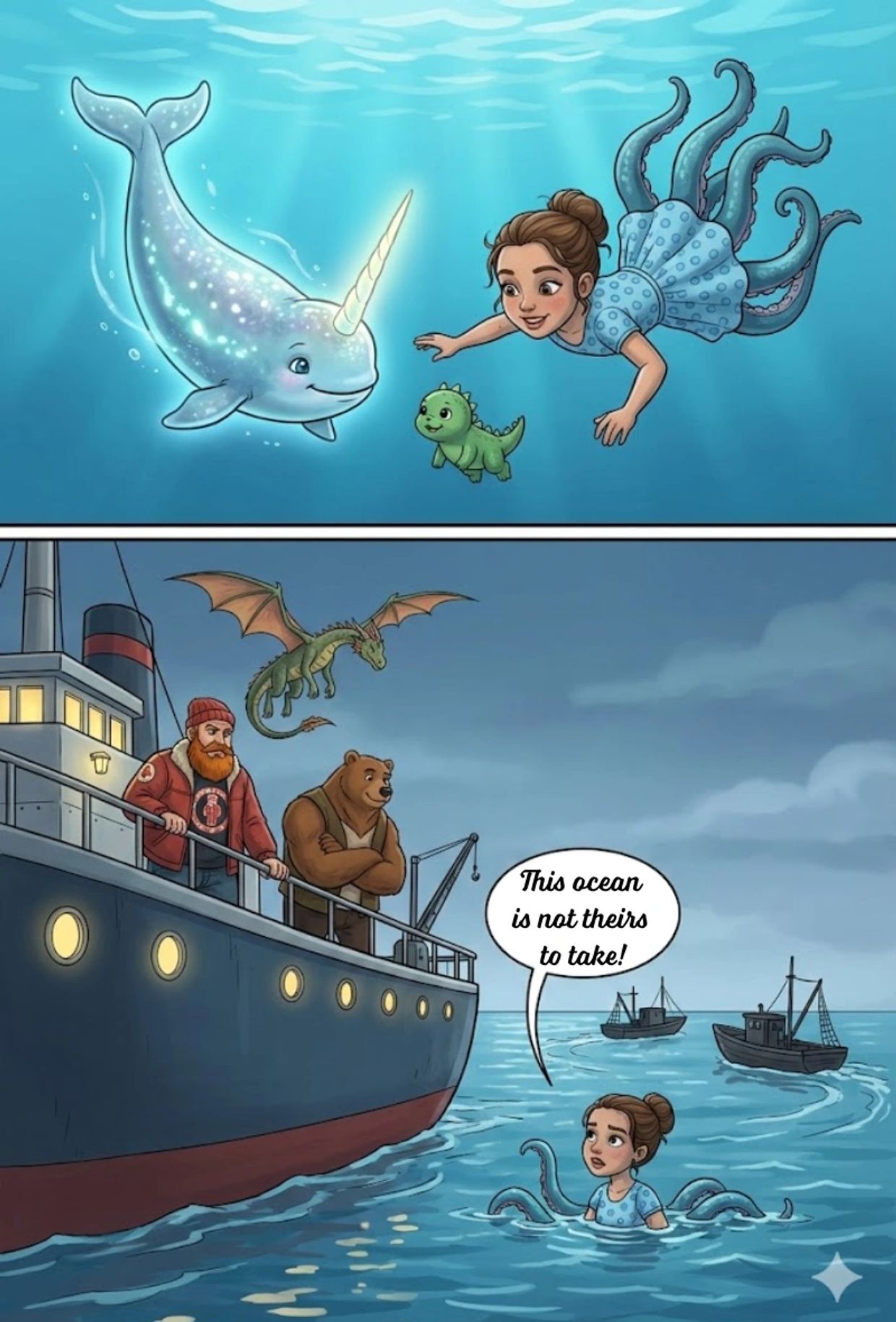
Josie the Kraken and the Sea Unicorn
One bright morning, while the ocean shimmered like a mirror, Josie the Kraken spotted something unusual in the distance.
It sparkled.
Not like treasure.
Not like sunlight.
It shimmered like magic.
Josie swam closer and gasped.
Floating just beneath the surface was a Sea Unicorn — a Narwhal — with a long, beautiful tusk that glowed softly in the water.
“Hello,” Josie said carefully.
The Sea Unicorn turned and smiled.
“My name is Lumi,” she said. “I’m exploring.”
Josie and Lumi swam together through icy-blue water, racing currents and playing hide-and-seek among drifting kelp. Bennett the Kaiju splashed along behind them, pretending to be a very fierce sea monster (he was not very convincing).
Everything felt perfect.
Then Josie felt it.
A wrong feeling.
The water trembled.
A low rumble echoed through the sea.
Boats.
Dark boats.
“They’re not explorers,” Josie whispered.
Lumi’s eyes widened.
“They want my tusk,” she said quietly. “They call me a prize.”
Josie’s tentacles curled tight.
“No one is a prize,” she said. “We run.”
The poachers’ nets dropped fast, slicing through the water. Bennett darted ahead, chomping through ropes as best he could.
Just then—
A horn sounded across the waves.
Uncle Red’s ship cut through the water, sails full and strong.
On deck stood Uncle Red, steady and calm.
Beside him was Pappa Comrade the Bear, tall and powerful, eyes fixed on the boats.
Above them, the sky roared.
Momma Dragon swept overhead, wings wide, fire glowing softly in her chest — not angry, but very serious.
The ocean felt different now.
Seen.
Uncle Red switched on the ship’s lights.
Pappa Comrade banged the rail with a mighty paw.
Momma Dragon swooped low, her shadow racing across the waves.
The poachers panicked.
They turned their boats hard, pulling in their nets and fleeing as fast as they could.
Soon, the sea was quiet again.
Lumi surfaced, breathing deeply.
“You came back for me,” she said.
Josie smiled.
“That’s what family does — even when we just met.”
Uncle Red tipped his hat.
“The ocean isn’t for taking,” he said. “It’s for protecting.”
Pappa Comrade nodded.
“And no one hurts a child of the sea on our watch.”
Momma Dragon circled once more, then vanished into the clouds.
Lumi swam close to Josie.
“Will I be safe?”
Josie nodded.
“As long as we keep watching.”
The Sea Unicorn dove into the deep blue, free once more.
Josie watched until the sparkle faded, her heart warm.
Some adventures are about exploring.
Some are about playing.
And some — the most important ones —
are about standing together and saying:
This ocean is not yours to take.
Josie the Kraken and the Ocean’s Fever
One morning, Josie the Kraken noticed something strange.
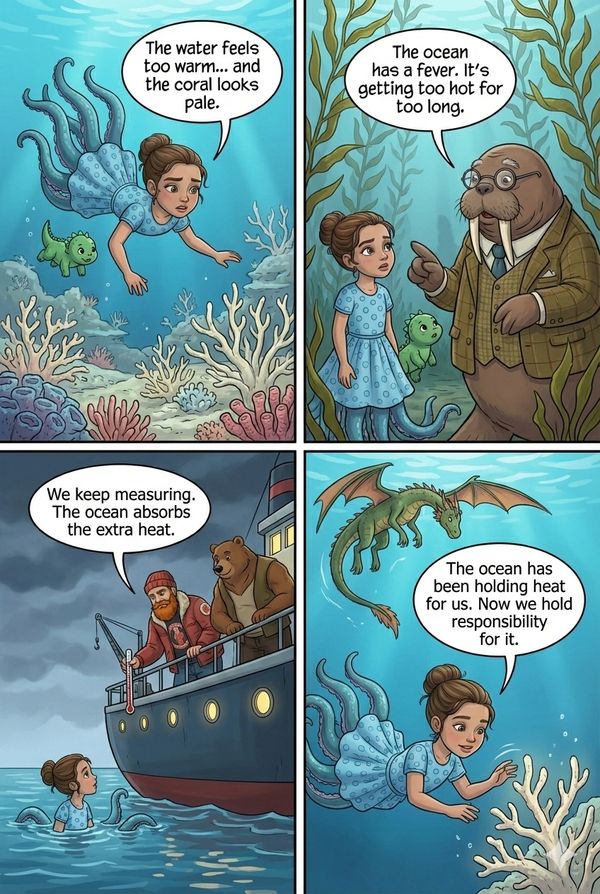
The water felt… warm.
Not sunshine-on-your-back warm.
Not cozy-blanket warm.
Too warm.
She swam past her favourite coral garden and stopped.
The coral didn’t glow pink and gold like it usually did. It looked pale. Quiet.
“Tired,” Josie whispered.
Bennett the Kaiju paddled beside her.
“Reef look sleepy,” he said.
Grandpa Walrus drifted up from below, whiskers swaying.
“The ocean has a fever,” he said gently.
Josie blinked. “Oceans don’t get fevers.”
“They do when they get too hot for too long,” Grandpa said. “And lately, that’s been happening more and more.”
Josie swam farther out.
The kelp forest she loved was thinner than before. Some tall strands had fallen away. Fish that usually darted through the leaves were gone.
“Where did everyone go?” she asked.
“Some swam north, searching for colder water,” Grandpa explained. “Some are still here, trying to adapt. But not everything can move.”
They passed a patch of coral that had turned almost white.
“When the water stays too warm,” Grandpa continued, “coral can lose the tiny living partners that give it colour and strength. That’s called bleaching.”
Josie reached out carefully. The coral felt fragile.
Above them, the sky darkened slightly. The sea rolled with restless energy.
“And warm water can make storms stronger,” Grandpa added. “More heat means more power.”
Josie thought about the villages along the shore. About boats. About families who depended on calm seasons and steady fish.
“It’s not just the reef, is it?” she said quietly.
Grandpa shook his head. “When the ocean overheats, the whole world feels it.”
At that moment, a shadow passed overhead.
Uncle Red leaned over the rail of his ship, lowering a thermometer into the sea. Pappa Comrade the Bear stood beside him, steady and watchful.
“We keep measuring,” Uncle Red said. “If we know how hot it is, we know how serious it’s getting.”
Josie surfaced.
“Why is the ocean holding so much heat?” she asked.
“The air above the sea is warming,” Uncle Red explained. “And the ocean absorbs most of that extra heat. It’s been helping us for a long time.”
“But helping hurts it,” Josie said.
“Yes,” Pappa Comrade answered softly. “And now we have to help back.”
That evening, Momma Dragon flew low across the water, her wings stirring cooler air. Not to fix everything — but to remind them they were not helpless.
Uncle Red spoke about protecting kelp forests and mangroves — places that help steady the coast and give young fish a place to grow.
“Healthy ecosystems are stronger,” he said. “They can handle more change.”
Josie returned to the reef again the next day. The water was still warmer than it should be. The coral was still pale.
But she fanned fresh water gently across it anyway.
Because a fever doesn’t mean the end.
It means someone needs care.
Josie looked up at the surface where sunlight shimmered.
“The ocean has been holding heat for us,” she said.
“Now we hold responsibility for it.”
And far out across the sea, the water rolled — warm, watchful, and waiting.

What Is a Marine Heat Wave?
A Marine Heat Wave is exactly what it sounds like:
It’s a period when the ocean becomes much warmer than normal — and stays that way for weeks or even months.
It is not just a warm afternoon.
It is not just summer.
It is an extended spike in ocean temperature that pushes marine life beyond what it can comfortably handle.
Why Does It Happen?
The ocean absorbs more than 90 percent of the extra heat trapped by greenhouse gases in the atmosphere.
For decades, the ocean has been acting like a giant heat sponge — quietly protecting us from even more extreme warming on land.
But that heat does not disappear.
It builds up.
As the average temperature of the ocean rises, it becomes easier for extreme warming events to happen. What used to be rare is now becoming more common.
Over the past decade, Marine Heat Waves have increased significantly in frequency and intensity.
What Happens During One?
When the ocean stays too warm for too long:
- Coral reefs can bleach and die.
- Kelp forests can collapse.
- Fish and marine mammals may shift to cooler waters.
- Food chains become disrupted.
The timing of life in the ocean — spawning, feeding, migration — depends on stable conditions. When temperature patterns change, those systems can unravel.
And unlike a human fever, the ocean does not recover quickly once it overheats.
Why It Matters to People
Marine Heat Waves do not stay offshore.
Warmer waters can fuel stronger storms and heavier rainfall.
Fisheries may experience sudden stock declines.
Aquaculture operations can face disease outbreaks.
Coastal economies built around reefs and wildlife can suffer.
The ocean helps regulate climate, produces much of the oxygen we breathe, and feeds billions of people.
When it overheats, we feel it — even on land.
Can Anything Be Done?
Marine Heat Waves cannot be reversed instantly.
But their frequency and severity can be limited.
Two actions matter most:
- Reducing fossil-fuel-based greenhouse gas emissions.
- Protecting and restoring healthy ecosystems like mangroves, kelp forests, seagrass meadows, and wetlands.
Healthy ecosystems are more resilient. They buy time.
Why Monitoring Matters
Scientists and research teams measure ocean temperatures, track biodiversity, and monitor ecosystem changes.
If we do not measure the fever, we cannot understand it.
And if we do not understand it, we cannot respond effectively.
Marine Heat Waves are not a distant possibility.
They are already happening.
What we do now determines how high the ocean’s fever climbs — and how well it can recover.
Josie the Kraken and the Arctic Adventure
.png/:/cr=t:0%25,l:0%25,w:100%25,h:100%25/rs=w:1240,cg:true)
Part 1: The Journey North
It was a very special morning.
Josie the Kraken woke up early, her tentacles wiggling with excitement.
“Today feels important,” she said.
Bennett the Kaiju blinked sleepily.
“Is it cake day?”
Josie smiled.
“It’s a birthday somewhere. I can feel it.”
Just then, Uncle Red called from the deck.
“Josie, Bennett — we’re heading north.”
“How far north?” Josie asked.
Uncle Red looked out over the water.
“As far as the ice used to be.”
Josie tilted her head.
“Used to be?”
The ship sailed for days. The water grew colder. The air turned crisp. Snow began to fall softly around them.
And then, they saw it.
Ice.
But not as much as Uncle Red expected.
He stood quietly at the rail.
“There used to be more,” he said.
Josie looked out across the ocean. Instead of wide, endless white, there were broken pieces drifting far apart.
“It looks… different,” she said.
Before anyone could say more, a shimmer of light appeared across the ice.
A voice carried gently through the cold air.
“Hello?”
Josie turned.
Standing on a nearby ice floe were Elsa and Anna, with Olaf waving happily and Sven stamping his hooves beside them.
“You made it!” Anna called.
Josie’s eyes went wide.
“You’re real!”
Olaf waddled forward.
“Of course we are! Also, it’s very cold. I like it.”
Elsa smiled softly, but her eyes were thoughtful as she looked out over the water.
“It wasn’t always like this,” she said quietly.
Josie swam closer.
“Uncle Red said the same thing.”
Anna nodded.
“We’ve been travelling farther and farther to find the ice,” she said.
Bennett looked around.
“Where ice go?”
No one answered right away.
The wind moved gently across the water, carrying a quiet feeling with it.
Uncle Red stepped forward.
“That’s what we’re here to understand.”
Elsa looked at Josie.
“Would you like to help us?”
Josie didn’t hesitate.
“Yes.”
Olaf clapped his tiny hands.
“Adventure!”
Josie looked out at the scattered ice, then back at her friends.
This wasn’t a story about magic fixing everything.
This was a story about learning, listening, and understanding what had changed.
And somewhere out there — across the water, across the ice, and along the land — were answers waiting to be found.
Josie took a small breath.
“Let’s go see,” she said.
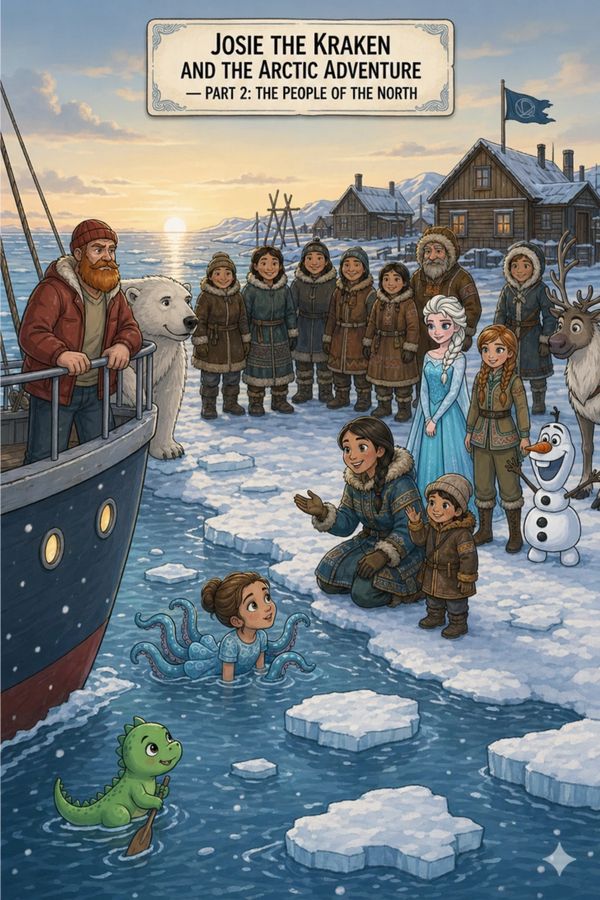
Part 2: The People of the North
The wind was quiet that morning.
Josie floated near the edge of the ice while Uncle Red guided the ship toward a small community along the shore. Snow rested gently on the land, and a few wooden buildings stood facing the sea.
“We’re going to visit friends,” Uncle Red said. “We listen first.”
Josie nodded.
Elsa and Anna stepped onto the snow with Sven, while Olaf carefully followed behind, watching his footing.
Near the shoreline, a group of people waited to greet them. They wore warm, layered clothing, and their smiles were calm and welcoming.
A woman stepped forward.
“My name is Anna,” she said. “Welcome.”
Josie stayed close to the water but listened carefully.
Anna smiled.
“We’ve come to learn about the ice.”
Anna looked out toward the sea.
“It is still part of our lives,” she said. “We travel across it. We watch it. We plan our days around it.”
Josie tilted her head.
“Uncle Red said the ice used to be bigger.”
Anna nodded gently.
“It forms later now,” she said. “And it breaks earlier.”
Josie thought about the scattered pieces she had seen.
“What does that change?” she asked.
Anna knelt near the shoreline so she could speak closer to Josie.
“When the ice changes, our paths change,” she said. “Some routes we used before are not always there. We choose new ways. We move with care.”
Uncle Red listened quietly.
Pappa Comrade stood beside him, steady as always.
A young child stepped forward and waved at Josie.
Josie waved back with one careful tentacle.
“We watch the animals too,” Anna continued. “They move differently some seasons. We learn from them, and they learn from the land.”
Elsa looked out over the snow-covered ground.
“You’ve always lived with the ice,” she said softly.
Anna smiled.
“We live with the land and the sea together,” she said. “They teach us how to move forward.”
Josie felt something important in those words.
Not worry.
Not fear.
Something steady.
“Learning,” she said quietly.
Anna nodded.
“Yes.”
Bennett stepped forward, leaving small prints in the snow.
“We help?” he asked.
Anna smiled at him.
“You already are,” she said.
Josie looked from the people, to the shore, to the wide, open water beyond.
The ice was changing.
The paths were changing.
But the people were still there — watching, learning, and finding their way.
As the sun dipped lower in the sky, Josie returned to the water.
She looked back at the shore one more time.
“This place has stories,” she said.
Uncle Red nodded.
“And we’re just beginning to hear them.”
Josie took a breath.
There was more to learn.
And she was ready.
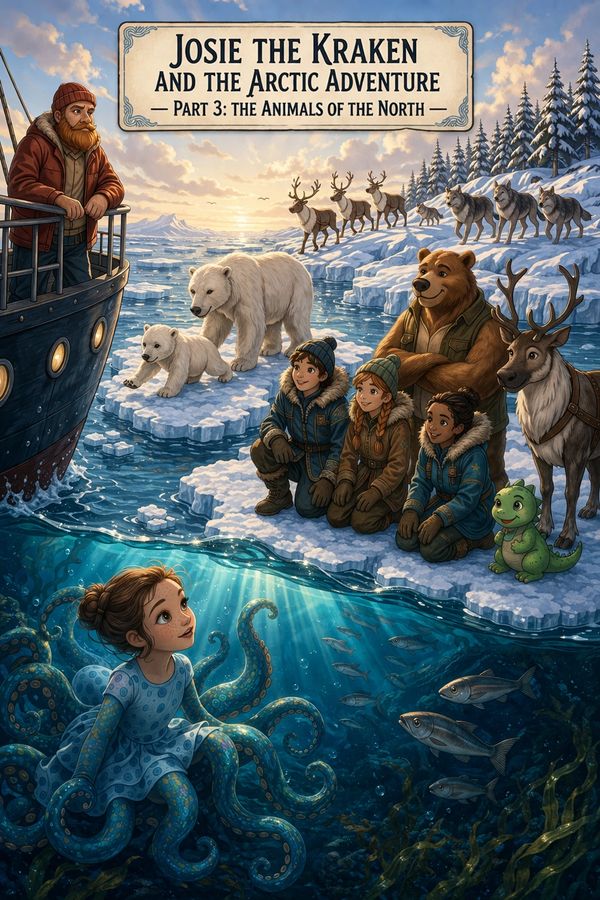
Part 3: The Animals of the North
The next day, Josie followed a narrow path between drifting ice.
The air was crisp.
The water was quiet.
“This is where we watch,” Uncle Red said. “No rushing.”
Josie slowed her swimming.
On a distant ice floe, a polar bear stood with her cub. The cub wobbled, then slid a little on the smooth surface. The mother stayed close, guiding each step.
“They travel on the ice,” Anna whispered.
Elsa nodded.
“It’s part of how they move and hunt.”
Josie watched carefully.
The ice stretched out, but not as far as before. There were wider gaps of open water between each piece.
The bear paused at the edge, looking across the water before stepping forward.
“She’s choosing her path,” Josie said.
Uncle Red nodded.
“Every step matters.”
They moved on.
Along the shoreline, a small group of reindeer crossed the snow, their hooves tapping softly as they walked together.
Sven lifted his head and gave a gentle call. The herd paused, then continued on their way.
“They follow the seasons,” Anna said. “They know where to go.”
Josie noticed the ground beneath them.
Some places were firm and snowy. Others looked softer, darker.
“The land feels different,” she said.
Pappa Comrade stood nearby.
“They adjust,” he said quietly. “Step by step.”
Farther along, near the edge of the forest, a wolf pack moved together through the snow.
They didn’t rush.
They didn’t spread out.
They stayed close, moving as one.
“They work together,” Bennett said.
“Yes,” Josie replied.
Above them, the sky shifted in colour as the light changed.
Below them, the sea moved steadily, carrying small fish through the cold water.
Josie dipped beneath the surface and looked up at the ice from below.
The shapes were thinner in places. The light passed through differently.
“It all connects,” she said softly.
Uncle Red leaned over the rail.
“It does.”
Josie returned to the surface.
The bear, the reindeer, the wolves, the sea — each one moving, adjusting, continuing.
She watched them for a long moment.
“They’re learning too,” she said.
Uncle Red smiled.
“They always have been.”
Josie looked out across the Arctic.
There was more space between the ice.
More movement in the water.
More decisions being made, one step at a time.
And everywhere she looked, life was still there — moving forward.
Josie gave a small nod.
“Let’s keep going,” she said.
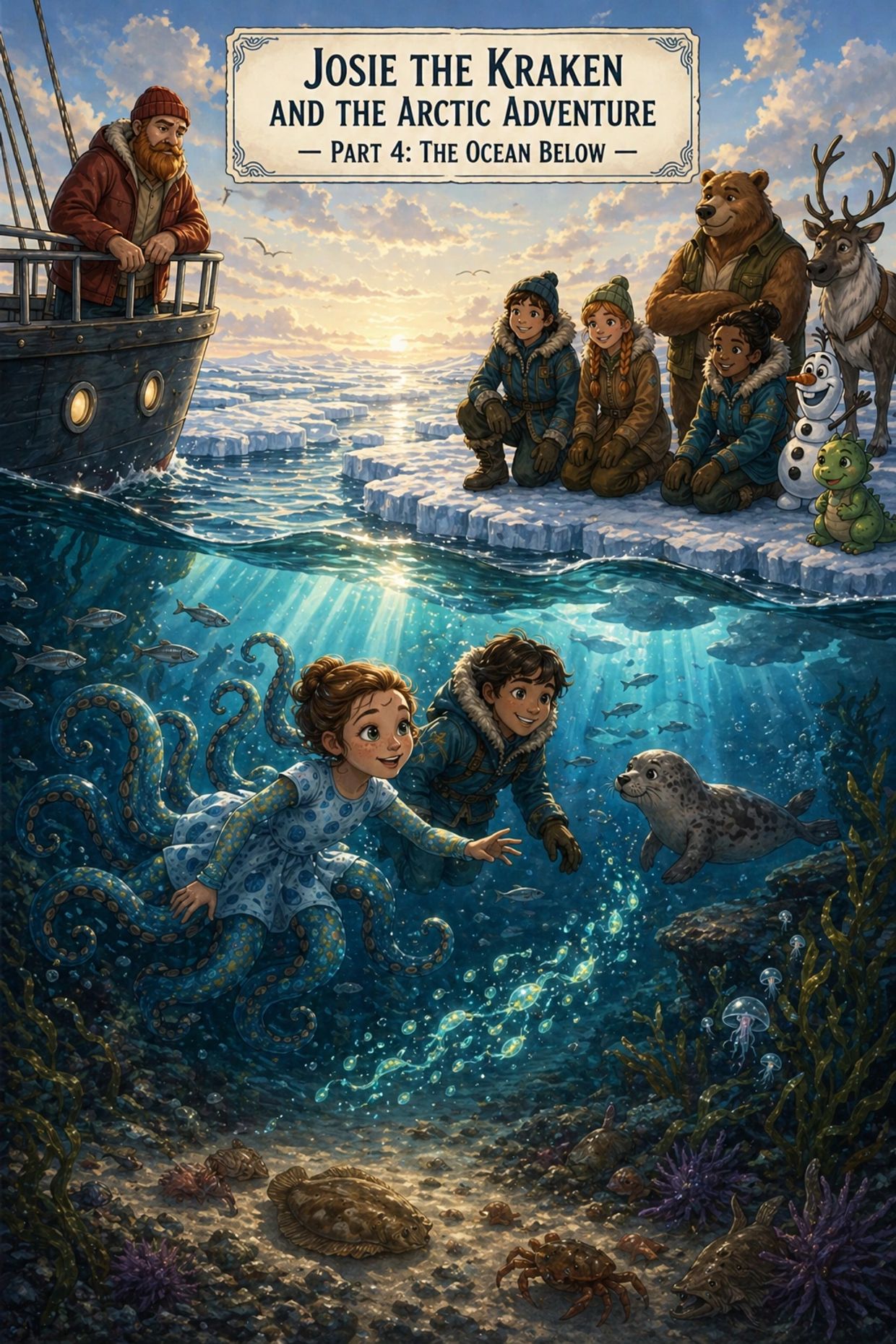
Part 4: The Ocean Below
The sea was very still that morning.
Josie slipped beneath the surface, leaving the quiet ice behind.
“Today,” Uncle Red said from the deck above, “we look below.”
Josie nodded and dove deeper, with Bennett close beside her.
The water was cold and clear. Light filtered down in soft beams through the spaces between the ice.
“It feels different here,” Josie said.
“It is,” Uncle Red replied. “The ice above shapes what happens below.”
Josie looked up. The ice was thinner in places, with more open water between the floes. The light moved differently, shifting gently as the surface changed.
Small fish swam through the cold water in loose groups. A seal drifted past, curious for a moment before continuing on its way.
Bennett turned in a slow circle.
“Lots of space,” he said.
Josie watched the currents. They moved steadily, carrying tiny bits of life through the water.
“When the ice changes,” Uncle Red explained, “the light and the water move differently. That can change where animals go and how they find food.”
Josie followed a trail of drifting plankton, glowing faintly as they moved.
“So everything adjusts,” she said.
“Yes,” Uncle Red answered. “Bit by bit.”
Farther down, the seafloor stretched wide and quiet. Small creatures moved along it, leaving soft tracks in the sand.
Josie hovered for a moment, taking it all in.
Above, the ice.
Below, the ocean.
All connected.
She rose slowly back toward the surface.
Elsa and Anna waited on a nearby floe, watching the water. Sven stood beside them, still and calm. Olaf waved as Josie appeared.
“Well?” Anna asked.
Josie rested at the edge of the ice.
“The ocean is changing with the ice,” she said. “Everything is moving together.”
Uncle Red nodded.
“That’s why we pay attention,” he said. “We learn how things are shifting so we know how to care for them.”
Josie looked out across the Arctic one last time.
The ice, the animals, the people, the water below — all part of the same story.
She took a quiet breath.
“We keep watching,” she said.
“And we keep learning.”
Uncle Red smiled.
“That’s how we move forward.”
The ship turned gently, beginning its journey south.
Behind them, the Arctic stretched wide and quiet — still full of life, still full of stories, still waiting to be understood.
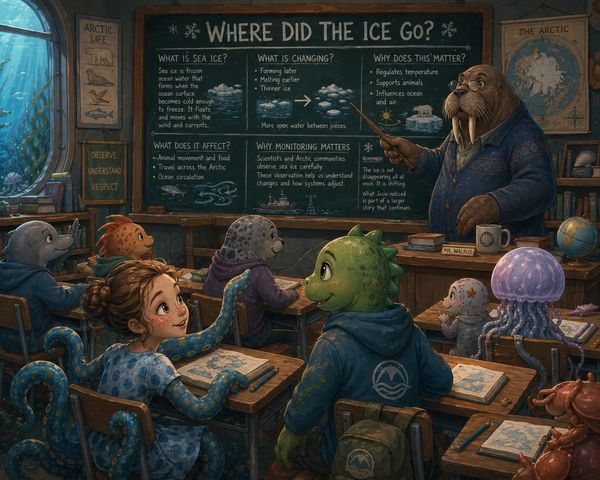
Where Did the Ice Go?
In Josie’s journey north, the ice did not stretch as far as expected.
That is because Arctic sea ice changes over time — in how much forms, how thick it becomes, and how long it stays.
It is not disappearing all at once.
It is shifting.
What Is Sea Ice?
Sea ice is frozen ocean water.
It forms when the surface of the ocean becomes cold enough to freeze. Unlike glaciers or ice sheets, it floats and moves with the wind and currents.
Some sea ice forms in winter and melts in summer.
Some used to remain for many years, building up thicker layers.
What Is Changing?
In many parts of the Arctic:
Sea ice is forming later in the year.
It is melting earlier in the season.
The ice that remains is often thinner.
Instead of wide, connected sheets, the ice is breaking into smaller pieces with more open water between them.
This is what Josie saw — not the ice gone, but the ice changing shape and timing.
Why Does This Matter?
Sea ice plays an important role in how the Arctic works.
It reflects sunlight, helping to regulate temperature.
It provides a surface for animals to travel and rest.
It influences how heat moves between the ocean and the air.
When the ice changes, these processes shift as well.
What Does It Affect?
Changes in sea ice can influence:
Where animals move and find food.
How people travel across the Arctic.
How ocean water circulates and mixes.
These changes are connected, moving through the system over time.
Why Monitoring Matters
Scientists and Arctic communities observe sea ice carefully.
They measure thickness, track movement, and record seasonal patterns.
These observations help build a clearer picture of how the Arctic is evolving and how systems are adjusting.
Watching the ice is one way of understanding the Arctic.
What Josie noticed is part of a larger story — one that continues to unfold, season by season.
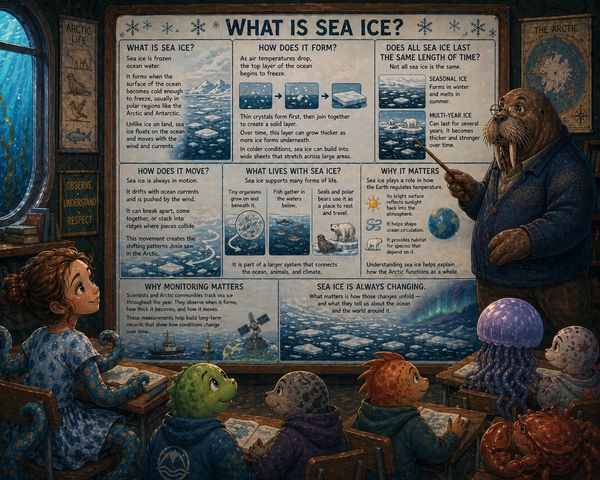
What Is Sea Ice?
Sea ice is frozen ocean water.
It forms when the surface of the ocean becomes cold enough to freeze, usually in polar regions like the Arctic and Antarctic.
Unlike ice on land, sea ice floats on the ocean and moves with the wind and currents.
How Does It Form?
As air temperatures drop, the top layer of the ocean begins to freeze.
Thin crystals form first, then join together to create a solid layer. Over time, this layer can grow thicker as more ice forms underneath.
In colder conditions, sea ice can build into wide sheets that stretch across large areas.
Does All Sea Ice Last the Same Length of Time?
Not all sea ice is the same.
Some ice forms in winter and melts in summer. This is called seasonal ice.
Other ice can last for several years. This older ice becomes thicker and stronger over time.
How Does It Move?
Sea ice is always in motion.
It drifts with ocean currents and is pushed by the wind. It can break apart, come together, or stack into ridges where pieces collide.
This movement creates the shifting patterns Josie saw in the Arctic.
What Lives With Sea Ice?
Sea ice supports many forms of life.
Tiny organisms grow on and beneath it.
Fish gather in the waters below.
Seals and polar bears use it as a place to rest and travel.
It is part of a larger system that connects the ocean, animals, and climate.
Why It Matters
Sea ice plays a role in how the Earth regulates temperature.
Its bright surface reflects sunlight back into the atmosphere.
It helps shape ocean circulation.
It provides habitat for species that depend on it.
Understanding sea ice helps explain how the Arctic functions as a whole.
Why Monitoring Matters
Scientists and Arctic communities track sea ice throughout the year.
They observe when it forms, how thick it becomes, and how it moves.
These measurements help build long-term records that show how conditions change over time.
Sea ice is always changing.
What matters is how those changes unfold — and what they tell us about the ocean and the world around it.
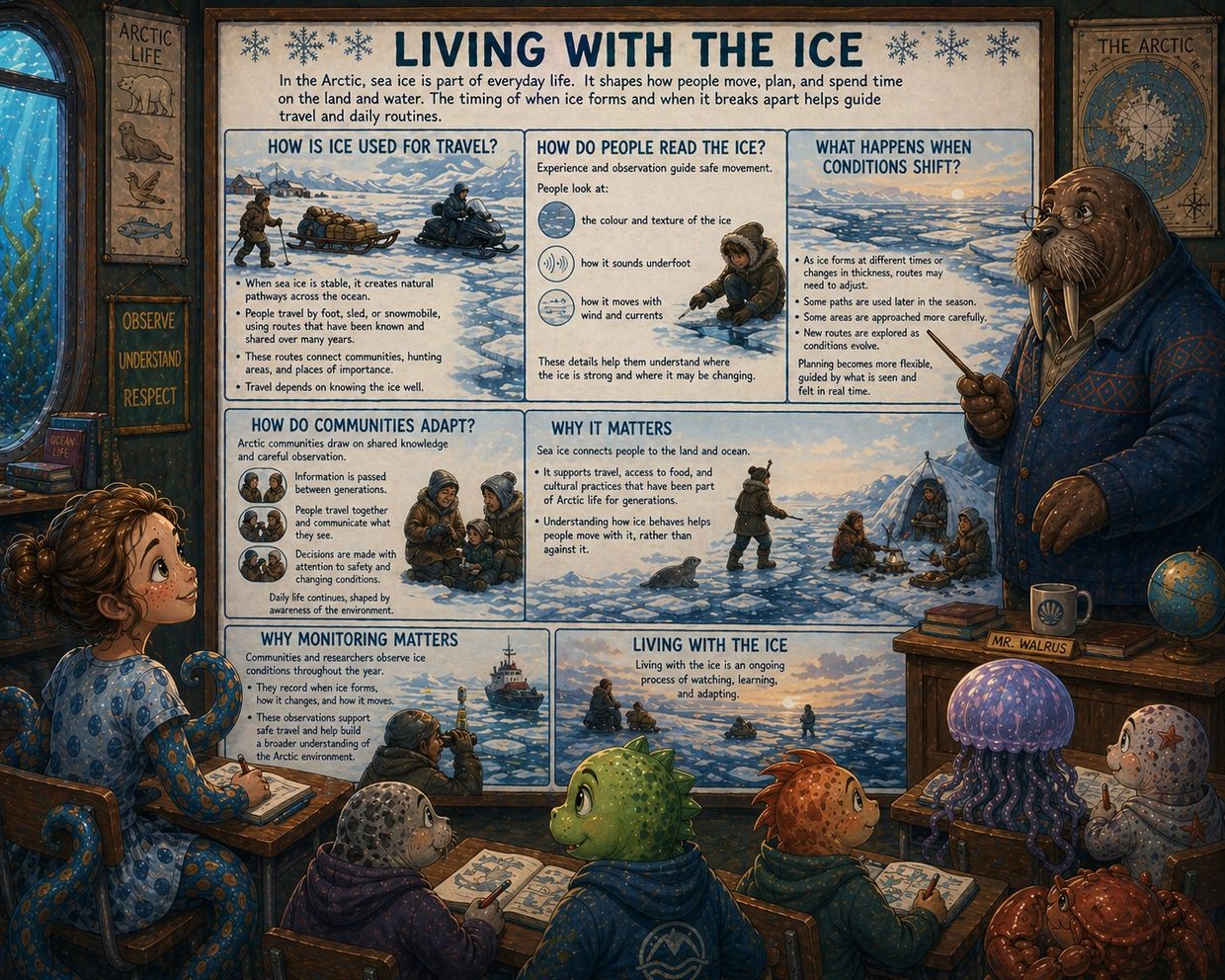
Living with the Ice
In the Arctic, sea ice is part of everyday life.
It shapes how people move, plan, and spend time on the land and water. The timing of when ice forms and when it breaks apart helps guide travel and daily routines.
How Is Ice Used for Travel?
When sea ice is stable, it creates natural pathways across the ocean.
People travel by foot, sled, or snowmobile, using routes that have been known and shared over many years. These routes connect communities, hunting areas, and places of importance.
Travel depends on knowing the ice well.
How Do People Read the Ice?
Experience and observation guide safe movement.
People look at:
- the colour and texture of the ice
- how it sounds underfoot
- how it moves with wind and currents
These details help them understand where the ice is strong and where it may be changing.
What Happens When Conditions Shift?
As ice forms at different times or changes in thickness, routes may need to adjust.
Some paths are used later in the season.
Some areas are approached more carefully.
New routes are explored as conditions evolve.
Planning becomes more flexible, guided by what is seen and felt in real time.
How Do Communities Adapt?
Arctic communities draw on shared knowledge and careful observation.
Information is passed between generations.
People travel together and communicate what they see.
Decisions are made with attention to safety and changing conditions.
Daily life continues, shaped by awareness of the environment.
Why It Matters
Sea ice connects people to the land and ocean.
It supports travel, access to food, and cultural practices that have been part of Arctic life for generations.
Understanding how ice behaves helps people move with it, rather than against it.
Why Monitoring Matters
Communities and researchers observe ice conditions throughout the year.
They record when ice forms, how it changes, and how it moves.
These observations support safe travel and help build a broader understanding of the Arctic environment.
Living with the ice is an ongoing process of watching, learning, and adapting.
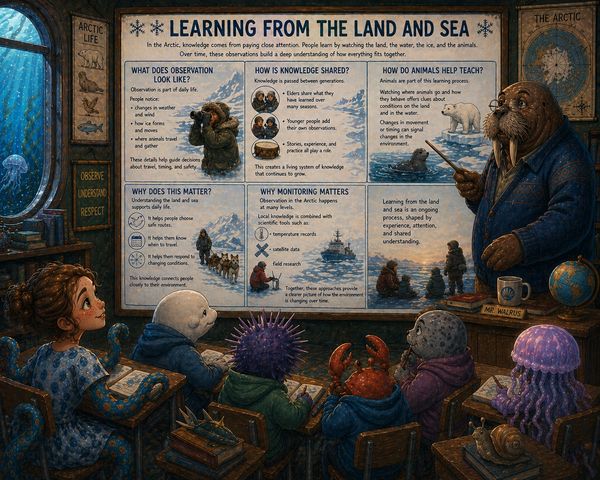
Learning from the Land and Sea
In the Arctic, knowledge comes from paying close attention.
People learn by watching the land, the water, the ice, and the animals. Over time, these observations build a deep understanding of how everything fits together.
What Does Observation Look Like?
Observation is part of daily life.
People notice:
- changes in weather and wind
- how ice forms and moves
- where animals travel and gather
These details help guide decisions about travel, timing, and safety.
How Is Knowledge Shared?
Knowledge is passed between generations.
Elders share what they have learned over many seasons.
Younger people add their own observations.
Stories, experience, and practice all play a role.
This creates a living system of knowledge that continues to grow.
How Do Animals Help Teach?
Animals are part of this learning process.
Watching where animals go and how they behave offers clues about conditions on the land and in the water.
Changes in movement or timing can signal changes in the environment.
Why Does This Matter?
Understanding the land and sea supports daily life.
It helps people choose safe routes.
It helps them know when to travel.
It helps them respond to changing conditions.
This knowledge connects people closely to their environment.
Why Monitoring Matters
Observation in the Arctic happens at many levels.
Local knowledge is combined with scientific tools such as temperature records, satellite data, and field research.
Together, these approaches provide a clearer picture of how the environment is changing over time.
Learning from the land and sea is an ongoing process, shaped by experience, attention, and shared understanding.
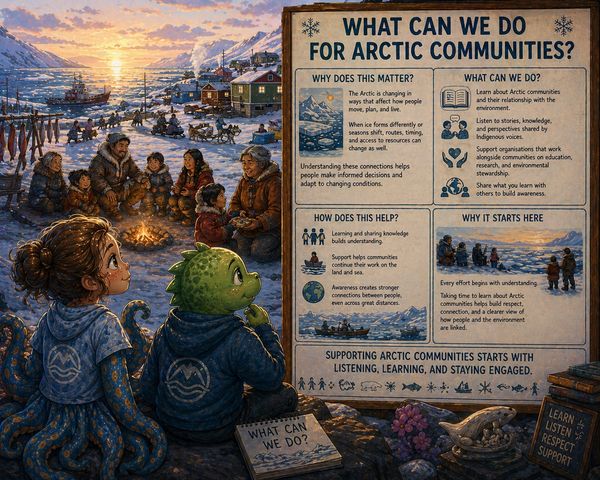
What Can We Do for Arctic Communities?
Arctic communities live closely connected to the land, sea, and ice.
Their knowledge comes from generations of observation, experience, and time spent on the land. This knowledge helps guide travel, food gathering, and daily life.
Why Does This Matter?
The Arctic is changing in ways that affect how people move, plan, and live.
When ice forms differently or seasons shift, routes, timing, and access to resources can change as well.
Understanding these connections helps people make informed decisions and adapt to changing conditions.
What Can We Do?
There are simple ways to show support and stay connected:
Learn about Arctic communities and their relationship with the environment.
Listen to stories, knowledge, and perspectives shared by Indigenous voices.
Support organisations that work alongside communities on education, research, and environmental stewardship.
Share what you learn with others to build awareness.
How Does This Help?
Learning and sharing knowledge builds understanding.
Support helps communities continue their work on the land and sea.
Awareness creates stronger connections between people, even across great distances.
Why It Starts Here
Every effort begins with understanding.
Taking time to learn about Arctic communities helps build respect, connection, and a clearer view of how people and the environment are linked.
Supporting Arctic communities starts with listening, learning, and staying engaged.
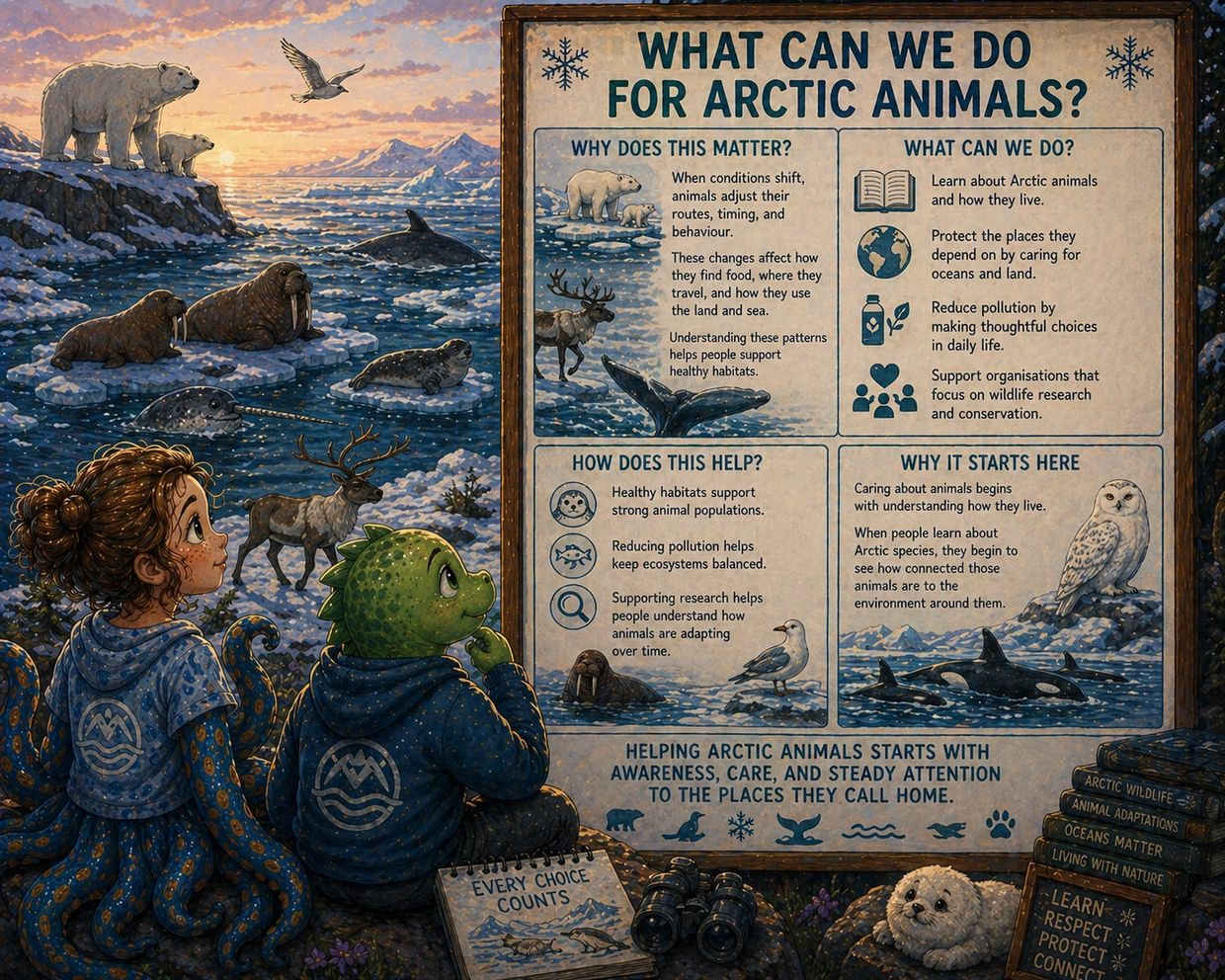
What Can We Do for Arctic Animals?
Arctic animals are adapted to a cold, seasonal environment.
They move with the ice, follow food across long distances, and rely on stable conditions to rest, hunt, and raise their young.
Why Does This Matter?
When conditions shift, animals adjust their routes, timing, and behaviour.
These changes affect how they find food, where they travel, and how they use the land and sea.
Understanding these patterns helps people support healthy habitats.
What Can We Do?
There are simple ways to help:
Learn about Arctic animals and how they live.
Protect the places they depend on by caring for oceans and land.
Reduce pollution by making thoughtful choices in daily life.
Support organisations that focus on wildlife research and conservation.
How Does This Help?
Healthy habitats support strong animal populations.
Reducing pollution helps keep ecosystems balanced.
Supporting research helps people understand how animals are adapting over time.
Why It Starts Here
Caring about animals begins with understanding how they live.
When people learn about Arctic species, they begin to see how connected those animals are to the environment around them.
Helping Arctic animals starts with awareness, care, and steady attention to the places they call home.
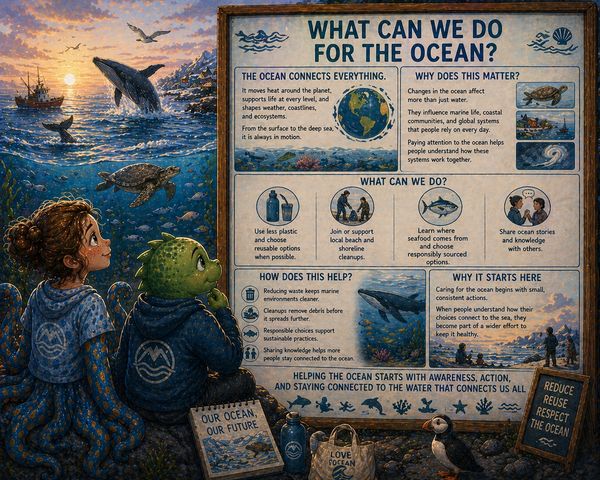
What Can We Do for the Ocean?
The ocean connects everything.
It moves heat around the planet, supports life at every level, and shapes weather, coastlines, and ecosystems. From the surface to the deep sea, it is always in motion.
Why Does This Matter?
Changes in the ocean affect more than just water.
They influence marine life, coastal communities, and global systems that people rely on every day. Paying attention to the ocean helps people understand how these systems work together.
What Can We Do?
There are simple ways to help:
Use less plastic and choose reusable options when possible.
Join or support local beach and shoreline cleanups.
Learn where seafood comes from and choose responsibly sourced options.
Share ocean stories and knowledge with others.
How Does This Help?
Reducing waste keeps marine environments cleaner.
Cleanups remove debris before it spreads further.
Responsible choices support sustainable practices.
Sharing knowledge helps more people stay connected to the ocean.
Why It Starts Here
Caring for the ocean begins with small, consistent actions.
When people understand how their choices connect to the sea, they become part of a wider effort to keep it healthy.
Helping the ocean starts with awareness, action, and staying connected to the water that connects us all.
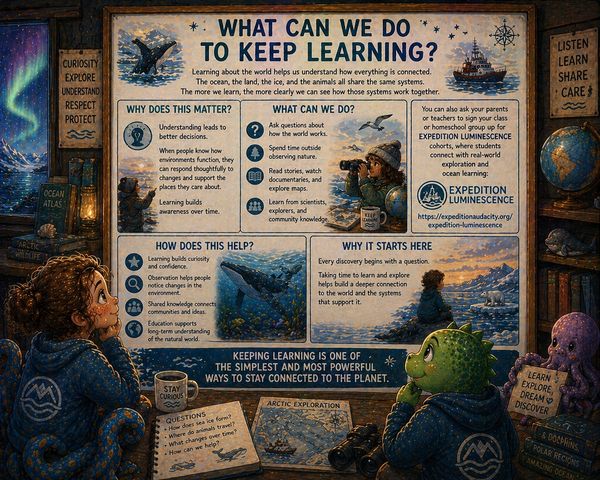
What Can We Do to Keep Learning?
Learning about the world helps us understand how everything is connected.
The ocean, the land, the ice, and the animals all share the same systems. The more we learn, the more clearly we can see how those systems work together.
Why Does This Matter?
Understanding leads to better decisions.
When people know how environments function, they can respond thoughtfully to changes and support the places they care about.
Learning builds awareness over time.
What Can We Do?
There are simple ways to keep learning:
Ask questions about how the world works.
Spend time outside observing nature.
Read stories, watch documentaries, and explore maps.
Learn from scientists, explorers, and community knowledge.
You can also ask your parents or teachers to sign your class or homeschool group up for Expedition Luminescence cohorts, where students connect with real-world exploration and ocean learning:
https://expeditionaudacity.org/expedition-luminescence
How Does This Help?
Learning builds curiosity and confidence.
Observation helps people notice changes in the environment.
Shared knowledge connects communities and ideas.
Education supports long-term understanding of the natural world.
Why It Starts Here
Every discovery begins with a question.
Taking time to learn and explore helps build a deeper connection to the world and the systems that support it.
Keeping learning is one of the simplest and most powerful ways to stay connected to the planet.